
Quick Answer
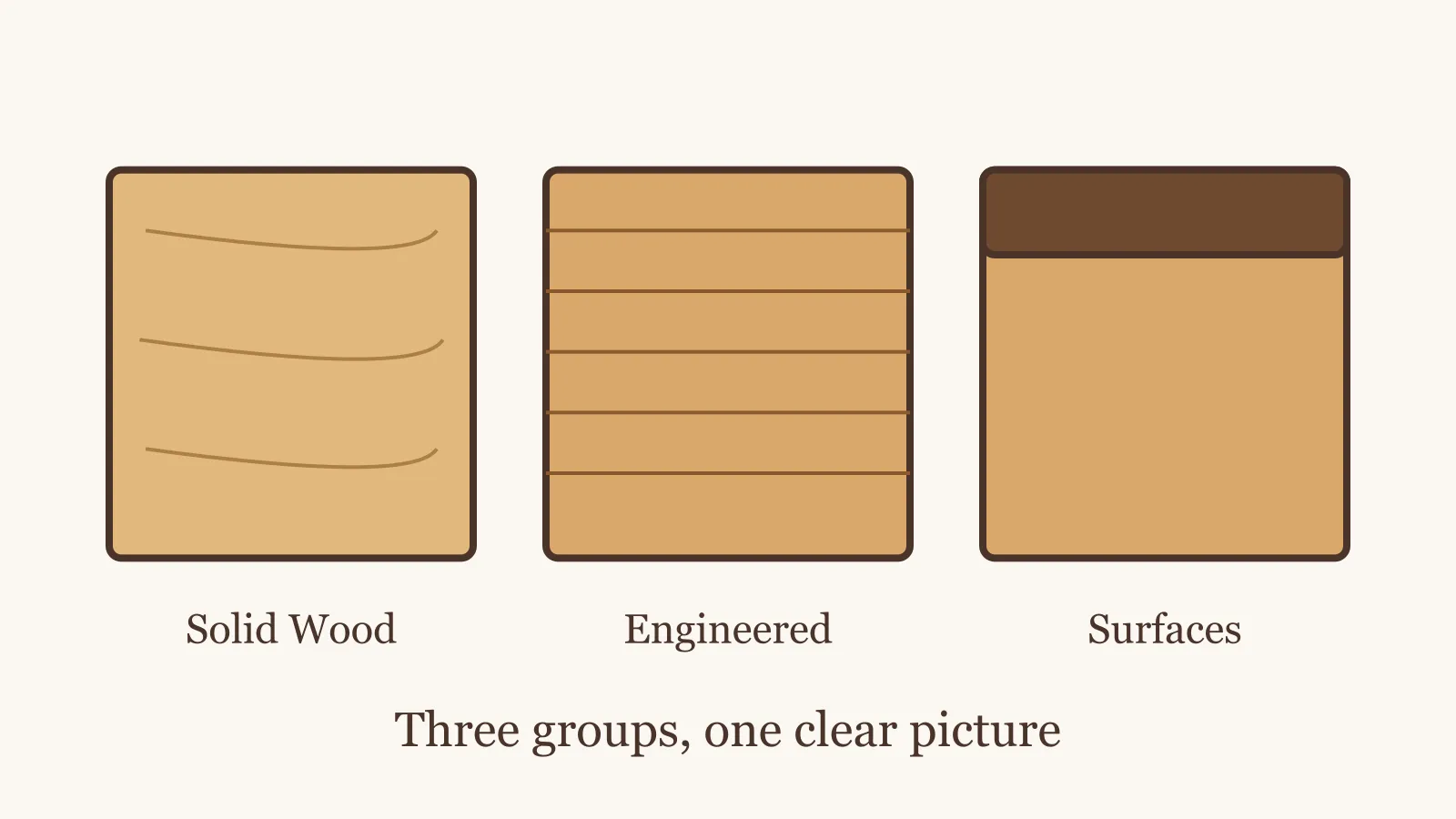
Furniture is made from three broad groups of wood-based material. Solid wood is lumber sawn directly from a tree. Engineered wood is a category of panels built from wood fibers, particles, strands, or veneers — including MDF, plywood, particle board, OSB, and HDF. Surface materials are the thin outer layers, such as veneer, laminate, and melamine, that change how a panel looks and behaves. This guide connects all three.
Solid Wood
Solid wood is wood used as a single piece, with the grain running continuously through the board. It is valued for strength, the ability to be sanded and refinished, and a natural appearance that ages well. It also moves with changes in humidity, expanding and shrinking across the grain.
Not every solid wood is the same. Species, grade, and drying all change how a board behaves. Two oak boards can differ in color, density, and stability, and oak as a species behaves differently from maple or walnut.
Read more: What Is Solid Wood?
Hardwood vs Softwood
The words hardwood and softwood describe the tree, not the board. Hardwoods come from broadleaf, flowering trees — the angiosperms — such as oak, maple, and walnut. Softwoods come from cone-bearing, coniferous trees — the gymnosperms — such as pine, spruce, and fir.
The names are misleading. Balsa, a famously light and soft wood, is a hardwood. Some softwoods are dense and hard. The botanical category says nothing reliable about how hard the lumber feels.
Read more: Hardwood vs Softwood
Engineered Wood
Engineered wood is not one material. It is a category covering any product manufactured from wood elements bonded with adhesive. The products look and behave differently because they are built differently.
MDF
MDF is pressed from refined wood fibers. It is smooth, dense, and uniform, with no grain and no layers. That makes it excellent for painted surfaces and routed details. Standard MDF is not waterproof.
Read more: What Is MDF?
HDF
HDF is a fiberboard pressed to a higher density than MDF. It is thin, hard, and stiff, and it is used where rigidity is needed in a small thickness, such as laminate flooring cores and door skins.
Read more: What Is HDF?
Particle Board
Particle board is pressed from wood particles and adhesive. It is lighter and coarser than MDF, and it is usually hidden beneath a laminate or melamine surface as an economical core.
Read more: What Is Particle Board?
Plywood
Plywood is built from thin veneers glued in alternating grain directions. The cross-lamination makes it strong, stable, and good at holding screws, and its edge shows the layers.
Read more: What Is Plywood?
OSB
OSB is made from large wood strands oriented in layers. It is a structural panel with a rough surface, used mainly for sheathing and subfloors rather than finished furniture.
Read more: What Is OSB?
Surface Materials
A surface material is the thin outer layer applied to a panel core. It changes what the piece looks like, how it feels, and how it resists wear and moisture.
Wood Veneer
Veneer is a thin layer of real wood bonded to a core. It gives a genuine wood surface while the core provides size and stability. Veneer can be lightly refinished within the limits of its thin layer.
Read more: What Is Wood Veneer?
Laminate
Laminate is a manufactured decorative surface made from layers of paper and resin. It is hard, wear resistant, and available in a huge range of colors and patterns, but it is not wood and cannot be refinished.
Read more: What Is Laminate?
Melamine
Melamine board is a panel — usually particle board or MDF — with a melamine resin surface fused to it. It arrives pre-finished and is the workhorse of budget and mid-range cabinetry.
Read more: What Is Melamine Board?
How Furniture Materials Differ
When comparing materials, it helps to look at the same properties each time.
Strength
Strength varies by product, species, grade, and construction. Plywood is generally strong for its weight; MDF is dense but weaker in screw holding; particle board is the least strong of the common panels.
Moisture
Standard MDF and particle board are the most moisture sensitive. Plywood is more tolerant, and rated grades exist for wetter conditions. A surface such as laminate resists moisture, but the core and edges still matter.
Surface Finish
MDF paints smoothly; veneer shows real grain; laminate and melamine arrive pre-finished. The finish you want often dictates the material.
Weight
MDF and OSB tend to be heavy; plywood is usually lighter; particle board is lightest of the common panels. Weight matters for large or wall-hung pieces.
Fastener Holding
Plywood holds screws well, including near edges. MDF is moderate. Particle board holds screws poorly, especially at edges, which is why flat-pack furniture hardware is designed around it.
Machining
MDF machines cleanly and takes routed profiles. Plywood machines well but shows layered edges. Particle board is the least suited to fine routing.
Typical Uses
MDF suits painted panels; plywood suits carcasses and structural work; particle board suits economical cores; veneer and laminate suit the visible surface.
How to Read Material Claims
When a product description says “solid wood” or “engineered wood” or “waterproof,” ask what it actually means.
- “Solid wood” may mean a glued-up panel, not a single board.
- “Engineered wood” names a category, not a specific material.
- “Waterproof” should be treated as a claim that needs a grade and specification.
- “Hardwood” names a botanical group, not a hardness rating.
Why Grade and Specification Matter
Two boards with the same name can behave very differently. Moisture-resistant MDF is not standard MDF. Exterior plywood is not interior plywood. A birch face veneer is not a poplar face veneer.
Whenever strength, moisture, or safety is involved, the product manufacturer’s specification takes priority over generic guidance.
Related Comparisons
References
See the References section for the sources used to write this page.