
Quick Answer
MDF, short for medium-density fiberboard, is an engineered wood panel made from wood fibers that are broken down, mixed with a synthetic resin, and pressed into sheets under heat and pressure. The result is a dense, flat, uniform board with a smooth surface and no visible grain. It is widely used in furniture, cabinets, interior trim, and shelving, especially where a painted or laminated finish is planned.
What Is MDF Made From?
MDF starts with wood — but not as planks or even as particles. The wood is reduced to individual fibers, a process that separates it far more finely than particle board production does. These fibers are combined with a resin binder, usually a urea-formaldehyde or moisture-resistant resin depending on the grade, and formed into a mat. The mat is then pressed under heat and pressure into a flat, dense panel.
Because the wood is broken down to the fiber level, MDF has no grain direction and no large internal gaps. This is the key difference between MDF and products such as plywood or particle board, which are built from layers or from coarser particles.
Not every MDF sheet is the same product. Density, resin type, and panel thickness vary by grade and manufacturer, and moisture-resistant or exterior-grade versions are made for specific applications.
What Does MDF Look and Feel Like?
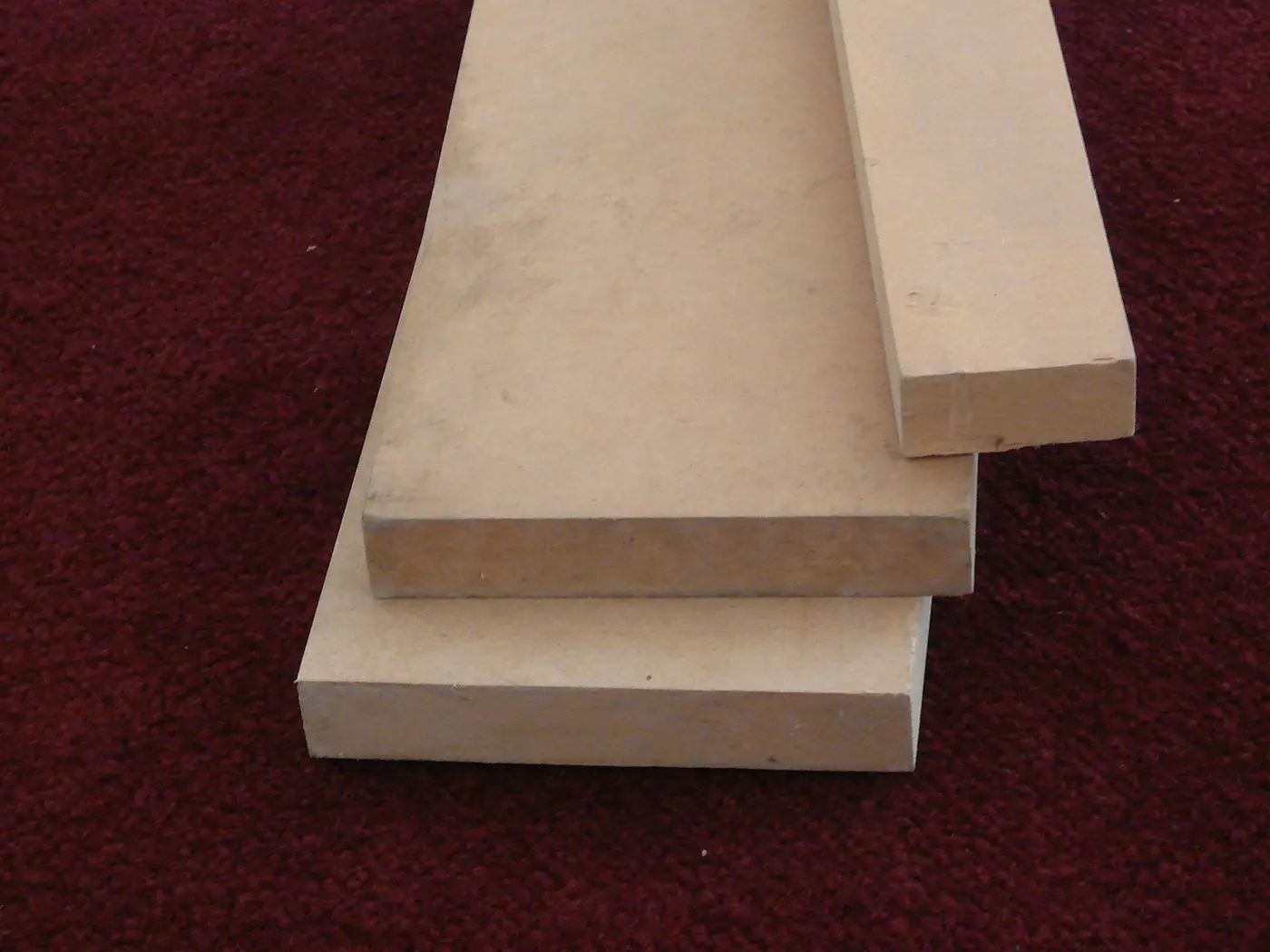
An unfinished MDF panel is smooth and even, with a fine, almost felt-like surface. The edges are uniform and dense, showing no layers and no large chips. When you cut it, the exposed edge is clean and flat rather than flaky.
That smoothness is exactly why MDF is popular for painted work. The surface accepts paint evenly and does not telegraph a grain pattern through the finish. The trade-off is weight: MDF is dense, and a large sheet is noticeably heavier than an equivalent sheet of plywood or particle board.
Where Is MDF Commonly Used?
MDF appears throughout furniture and interior work:
- Cabinet doors and panels, especially painted ones
- Furniture panels and drawer fronts
- Interior trim, baseboards, and moldings
- Shelving and flat-pack furniture components
- Door skins and speaker enclosures
It is most common indoors. Standard MDF is not intended for prolonged water contact or exterior exposure.
Advantages
- Smooth, uniform surface that paints well
- No grain, so no grain telegraphing through finishes
- Machines cleanly and accepts routed profiles and edges
- Consistent thickness and flatness
- Usually more affordable than solid wood and some plywood
Limitations
- Dense and heavy compared with many other panels
- Standard grades are not moisture resistant
- Edge screw holding is weaker than in plywood
- Raw edges are absorbent and should be sealed or banded
- Dust from cutting requires proper handling and ventilation
Is MDF Waterproof?
Standard MDF should not be assumed to be waterproof. When saturated, standard panels can swell and lose strength. Moisture-resistant grades exist, and their performance depends on the specific product and intended application.
The practical rule is simple: do not treat every MDF product as interchangeable. If a job involves moisture, check the panel grade and the manufacturer’s specification rather than relying on the general name.
MDF vs Related Materials
MDF is often confused with other panels. It is smoother and denser than particle board, which is built from coarser particles. It has no layers, unlike plywood, which is built from cross-laminated veneers. And it is an engineered product, not solid wood.
For direct comparisons, see:
- MDF vs Plywood
- MDF vs Particle Board
- HDF — a higher-density fiberboard
- Solid Wood
Common Mistakes
- Treating MDF and particle board as the same product
- Assuming moisture-resistant MDF is fully waterproof
- Judging a panel only by its surface, not its grade
- Using a general material conclusion instead of a product specification
- Leaving cut edges unsealed where moisture can enter
References
See the References section for the sources used to write this page.