
Quick Answer
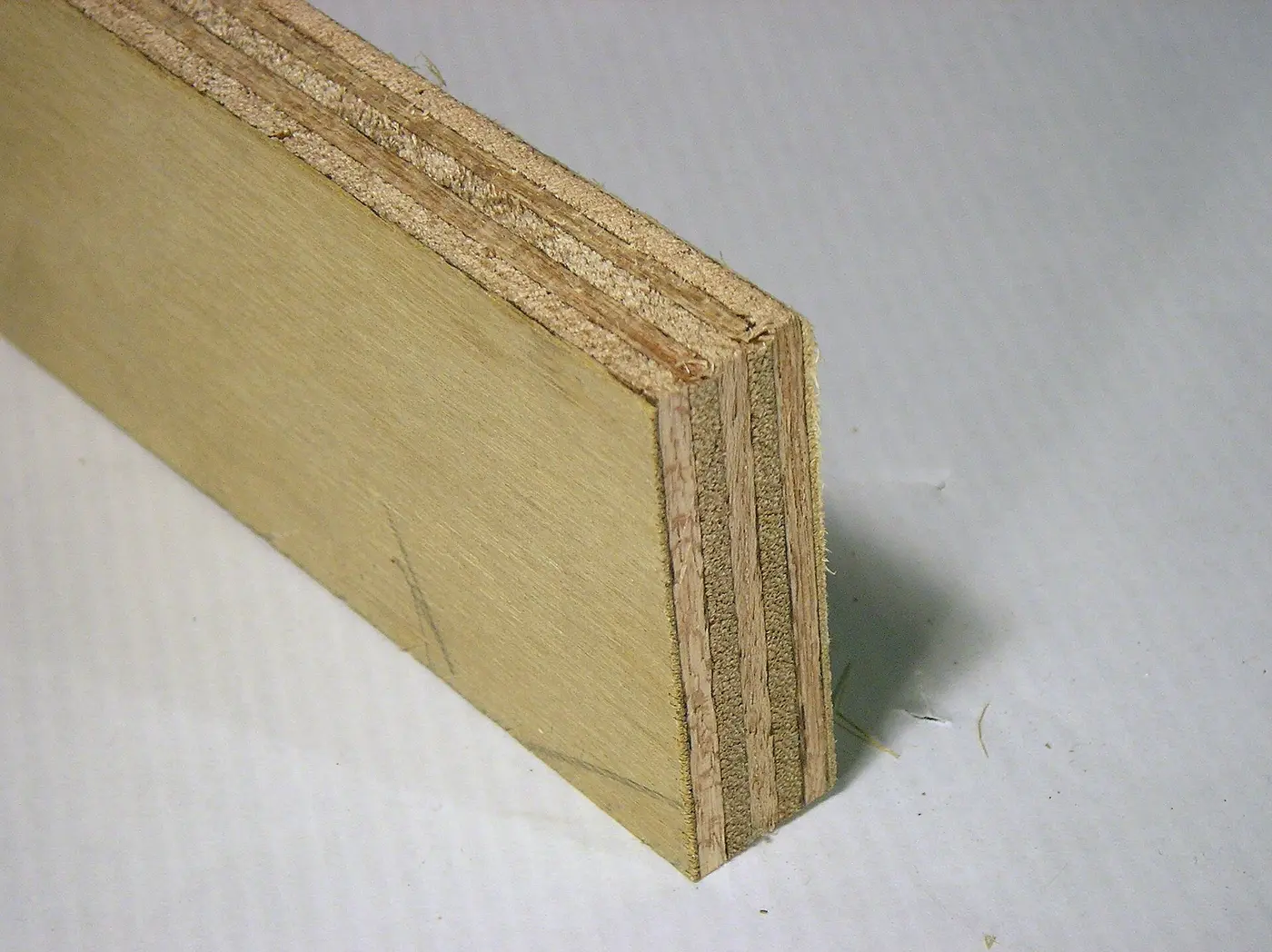
Plywood is an engineered wood panel made from thin sheets of wood veneer glued together in layers, with each layer’s grain running at an angle to the one beside it. This cross-lamination gives the panel strength in multiple directions, resistance to splitting, and good dimensional stability. Plywood is used for cabinets, furniture, shelving, flooring, and structural sheathing.
How Is Plywood Made?
Plywood starts with logs that are peeled or sliced into thin, continuous veneers. These veneers are dried, graded, and coated with adhesive. They are then stacked with alternating grain directions — a layer running lengthwise, the next crosswise — and pressed under heat into a panel.
The alternating grain is what makes plywood work. Wood is strong along its grain and weak across it. By crossing the layers, the panel evens out those differences and resists warping and splitting better than a solid board of the same size.
The number of layers, the species of the face veneer, the adhesive system, and the grade of each veneer all vary by product. A cabinet-grade plywood with a birch face is a different product from a construction-grade sheathing panel.
What Does Plywood Look Like?
The face of plywood shows the grain of its outer veneer, which can be anything from birch or oak to pine. The edges tell the real story: a plywood edge shows the individual layers stacked like a sandwich, with the veneers alternating direction.
That layered edge is both a feature and a drawback. It is strong, but it is not pretty, so visible plywood edges are usually covered with edge banding, a solid wood edge, or a frame.
Where Is Plywood Commonly Used?
- Cabinet carcasses and furniture frames
- Shelving and drawer boxes
- Table and desk tops beneath a finish
- Flooring and wall substrates
- Structural sheathing for walls, roofs, and floors
The right plywood for one job is not automatically right for another. Interior, exterior, and marine grades are designed for different exposure levels.
Advantages
- High strength and stiffness for its weight
- Good screw holding, including near edges
- Dimensional stability from cross-lamination
- Available in a wide range of grades and species
- Generally more moisture tolerant than particle board
Limitations
- Exposed edges require banding or treatment
- Face veneer can telegraph through thin paint
- Usually more expensive than particle board and MDF
- Quality varies significantly by grade and core construction
- Interior grades are not automatically exterior rated
Is Plywood Waterproof?
Plywood should not be assumed to be waterproof in every grade. Interior plywood is made with adhesives intended for dry conditions. Exterior and marine grades use more water-resistant adhesives and are suited to wetter environments, but even these have limits.
The manufacturer’s grade and specification take priority over the general name. If a panel will see repeated wetting, choose the rated product for that exposure.
Plywood vs Related Materials
Plywood is built from veneers, which distinguishes it from MDF (fibers), particle board (particles), and OSB (strands). It overlaps with solid wood in appearance but behaves differently because of its engineered layers.
Compare directly:
Common Mistakes
- Assuming every plywood is exterior grade
- Expecting painted plywood to hide the face grain automatically
- Leaving cut edges unsealed or unbanded where moisture can enter
- Judging a panel by its face species alone, ignoring the core grade
References
See the References section for the sources used to write this page.