
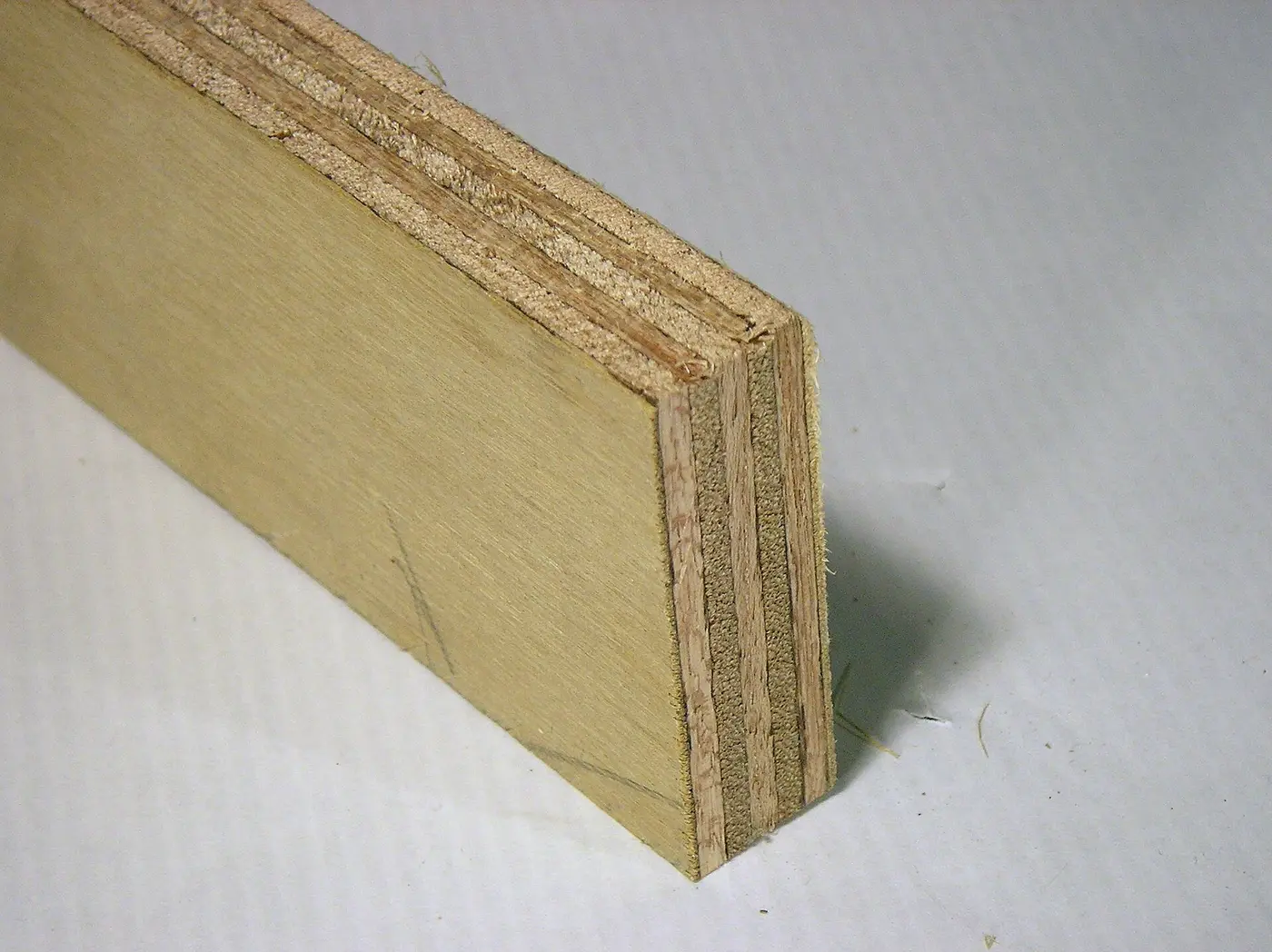
Quick Answer
Plywood labels describe different things. A pair of letters such as A-C identifies the appearance and permitted repairs of the face and back veneers. Exposure 1 or Exterior describes the durability of the glue bond under moisture exposure. A span rating describes a structural panel’s intended support spacing. Thickness, species group, sanding, overlay, and governing standard may appear elsewhere in the stamp.
Read the whole mark. A smooth A face does not by itself make a panel structural, waterproof, void-free, or suitable for permanent outdoor exposure.
Face and Back Veneer Grades
In U.S. softwood structural plywood, veneer grades generally run from A through D.
- A veneer is smooth and paintable, with tight limits on defects and repairs.
- B veneer is solid surfaced but permits more repairs and natural characteristics.
- C veneer permits larger defects and repairs and is common in structural panels.
- D veneer allows still more open defects and is limited to panels protected from long-term weather exposure.
A two-letter designation reads face first, back second. A-B plywood has an A-grade face and B-grade back. B-C has a better visible face and a utility back. The inner plies have their own requirements, which is one reason the face letters cannot tell you everything about core quality.
Hardwood decorative plywood may follow different voluntary standards or manufacturer grading systems. Terms such as “cabinet grade” are useful descriptions but are not a single universal grade. Ask for the applicable standard and a panel sample when appearance or core quality is critical.
Bond Classification: Exposure 1 vs Exterior
The bond classification concerns adhesive durability, not immunity from all moisture damage.
Exposure 1
Exposure 1 panels are made with a moisture-resistant bond intended to survive normal construction delays and occasional wetting. They are not intended for permanent weather exposure. The wood veneers can still swell, check, discolor, or decay if they remain wet.
Exterior
Exterior plywood uses an exterior bond and veneer grades permitted for long-term exposure. That still does not mean every exterior panel can be left unfinished in every climate. Edge sealing, finish, detailing, drainage, fasteners, species, and preservative treatment may all matter.
Interior
Interior panels are intended for protected, dry service. They may be perfectly suitable for furniture and cabinet interiors when the construction and surface quality match the job.
What CDX Actually Means
CDX is commonly used for sheathing with a C-grade face, D-grade back, and an Exposure 1 bond. The “X” is widely misunderstood as “exterior.” In ordinary retail use it points to exposure durability during construction, not permission for permanent outdoor service.
Check the actual stamp instead of decoding the nickname. A panel explicitly marked Exterior is a different specification from a typical C-D Exposure 1 sheathing panel.
Structural Panel Stamps
An APA trademark or comparable certification mark can include:
- the panel grade or intended use, such as Rated Sheathing;
- a span rating, such as 32/16;
- the bond classification;
- the performance category and decimal thickness;
- the governing standard and mill number.
For Rated Sheathing, the first span-rating number relates to roof support spacing and the second to subfloor support spacing under the conditions covered by the standard. It is not a general furniture strength score. Structural decisions should follow the complete panel specification and applicable building guidance.
Sanded, Overlaid, and Appearance Panels
Sanded plywood is manufactured for a smoother surface and is often sold with face/back grades. Medium-density overlay (MDO) and high-density overlay (HDO) add resin-treated surfaces for specialized finishing and repeated-use applications. Decorative hardwood plywood prioritizes the visible veneer species and matching, often over weather exposure or structural rating.
These categories can overlap, but one does not imply the others. A beautiful walnut-faced panel may have an interior bond. A rough structural panel may have an exterior bond. Select the surface and the construction separately.
Marine-Grade Plywood
Under the U.S. PS 1 framework summarized by APA, marine-grade plywood uses Douglas-fir or Western Larch veneers, B grade or better throughout, limited core gaps, sanded faces, and an Exterior bond. Those requirements make it suitable for demanding fabrication and bending applications.
Marine grade does not automatically mean preservative treated or immune to decay. If biological durability is required, treatment and species still need to be specified. It also does not replace appropriate coating, edge sealing, drainage, or maintenance in a boat or exterior assembly.
Choosing Plywood for Furniture
For a cabinet carcass, shelf, drawer box, or finished panel, look beyond the largest label on the rack:
- Inspect the face for patches, splits, grain match, and sanding quality.
- Examine the edges for core gaps and overlapping or unusually thin plies.
- Check flatness across the full sheet.
- Match the bond classification to realistic moisture exposure.
- Confirm actual thickness before choosing joinery or hardware.
- Ask whether the visible veneer is thick enough for the intended sanding and finish.
- Use the manufacturer’s span or load information when a shelf or structural panel is safety-critical.
For painted furniture, a smooth face and stable core may matter more than a decorative species. For clear-finished work, veneer quality and matching dominate. For a utility cabinet, a lower cosmetic grade may perform just as well at lower cost.
Common Buying Mistakes
- Treating the face grade as a strength rating.
- Assuming every panel sold as “cabinet grade” follows the same standard.
- Reading Exposure 1 as permanent exterior approval.
- Assuming marine plywood is rot-proof.
- Ignoring the back face when both sides will be visible.
- Designing joinery around nominal rather than measured thickness.
The most reliable approach is to write a short specification before shopping: visible face, back quality, core, thickness, bond class, structural rating if needed, and finish. That turns an ambiguous request for “good plywood” into a panel a supplier can actually identify.
References
See the References section for the industry and research sources used on this page.