
Quick Difference
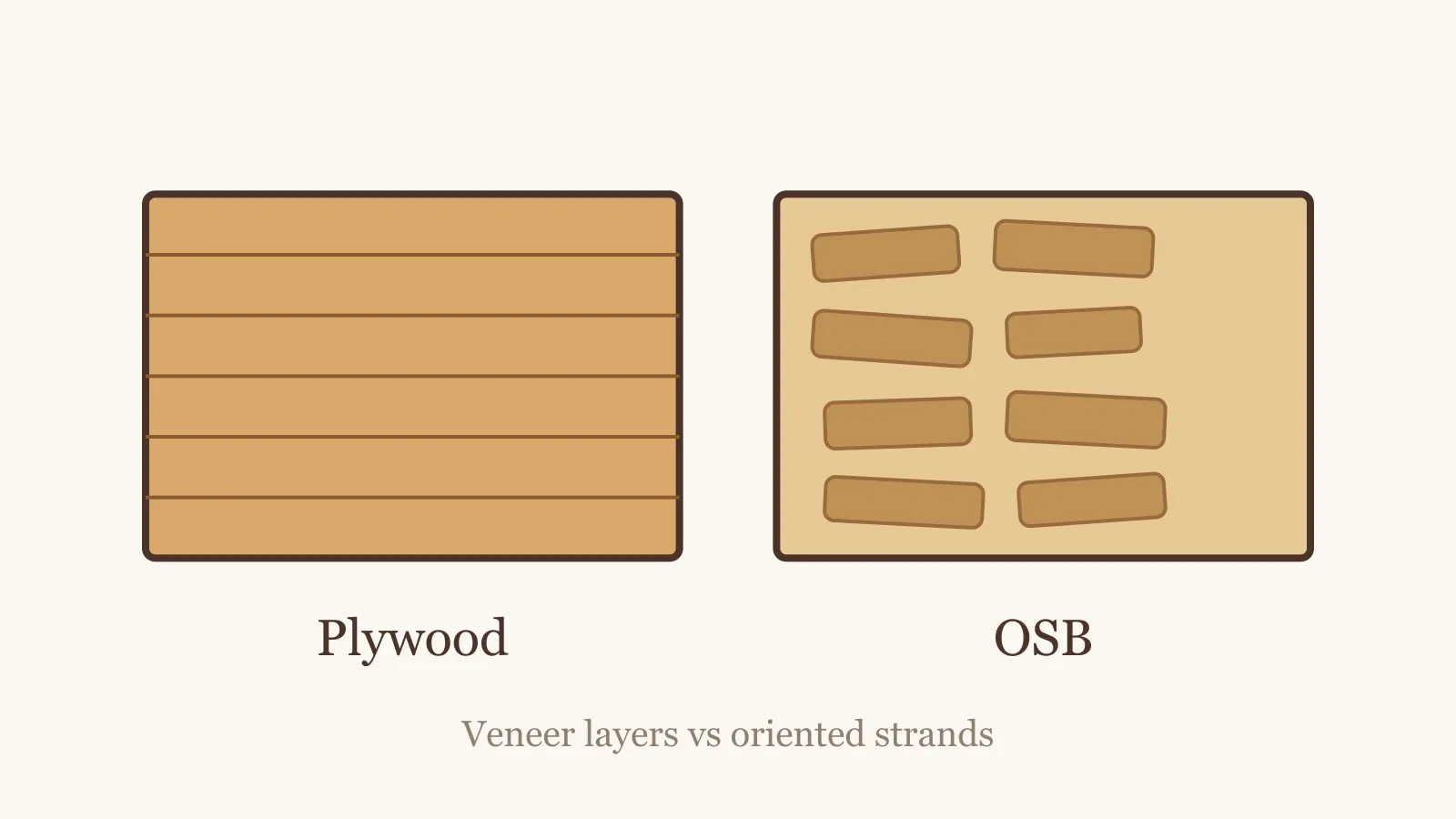
Plywood and OSB are both structural engineered panels, but they are made differently. Plywood is built from thin cross-laminated veneers and has a smooth face. OSB is built from large wood strands oriented in layers and has a rough, patterned surface. Plywood is the common choice for cabinetry and finished work; OSB is the common choice for wall, roof, and floor sheathing.
What Is Plywood?
Plywood is made from veneers glued in alternating grain directions. It is strong, stable, and holds screws well, with a face veneer that determines its look. See What Is Plywood?.
What Is OSB?
OSB is made from wood strands oriented in layers and bonded with resin. It is a structural panel with a rough surface, used mainly in construction. See What Is OSB?.
Construction
Both panels cross their layers for strength, but the element size differs. Plywood uses continuous veneer sheets; OSB uses large individual strands. That is why plywood has a smooth, finished face and OSB has a coarse, textured one.
Surface and Finishing
Plywood can be painted or clear-finished, and its face veneer can be chosen for appearance. OSB is not intended as a cosmetic surface; it is generally covered by other materials.
Moisture Performance
Both are manufactured in grades for different exposure levels. Plywood tends to dry more evenly, while OSB edges can swell if saturated. For both, the panel rating and edge treatment decide the actual performance.
Weight
OSB is often heavier than comparable plywood. That weight, plus the rough surface, is part of why OSB is less common in furniture.
Cost
OSB is usually less expensive than plywood, which is a major reason it dominates structural sheathing.
Typical Uses
Plywood is used for cabinet carcasses, shelving, furniture, and finished panels. OSB is used for wall and roof sheathing, subfloors, and structural bracing.
Which Should You Choose?
Choose plywood for finished surfaces, cabinetry, and work where appearance and screw holding matter. Choose OSB for structural sheathing where the panel will be covered and cost matters. The two serve different jobs more often than they compete for the same one.
References
See the References section for the sources used to write this page.