
Quick Answer
OSB, short for oriented strand board, is an engineered wood panel made from large wood strands that are layered, oriented in specific directions, and bonded with resin under heat and pressure. It is primarily a structural panel used for wall and roof sheathing and subfloors, rather than a finished furniture surface. Its strength, panel size, and cost make it a standard in construction.
How Is OSB Made?
OSB begins with small-diameter logs that are cut into long strands. These strands are dried, mixed with a resin binder, and formed into mats. Within each layer, the strands are aligned in one direction; the layers are then arranged so that the strand direction alternates, much like the cross-lamination in plywood.
The oriented strands give OSB much of its strength. Aligning the strands along the panel’s length makes the panel strong and stiff in that direction, while the cross layers add stability.
Like plywood, OSB is produced in grades for different exposure levels. The adhesive system and the panel rating decide where it can be used, not the name alone.
What Does OSB Look Like?
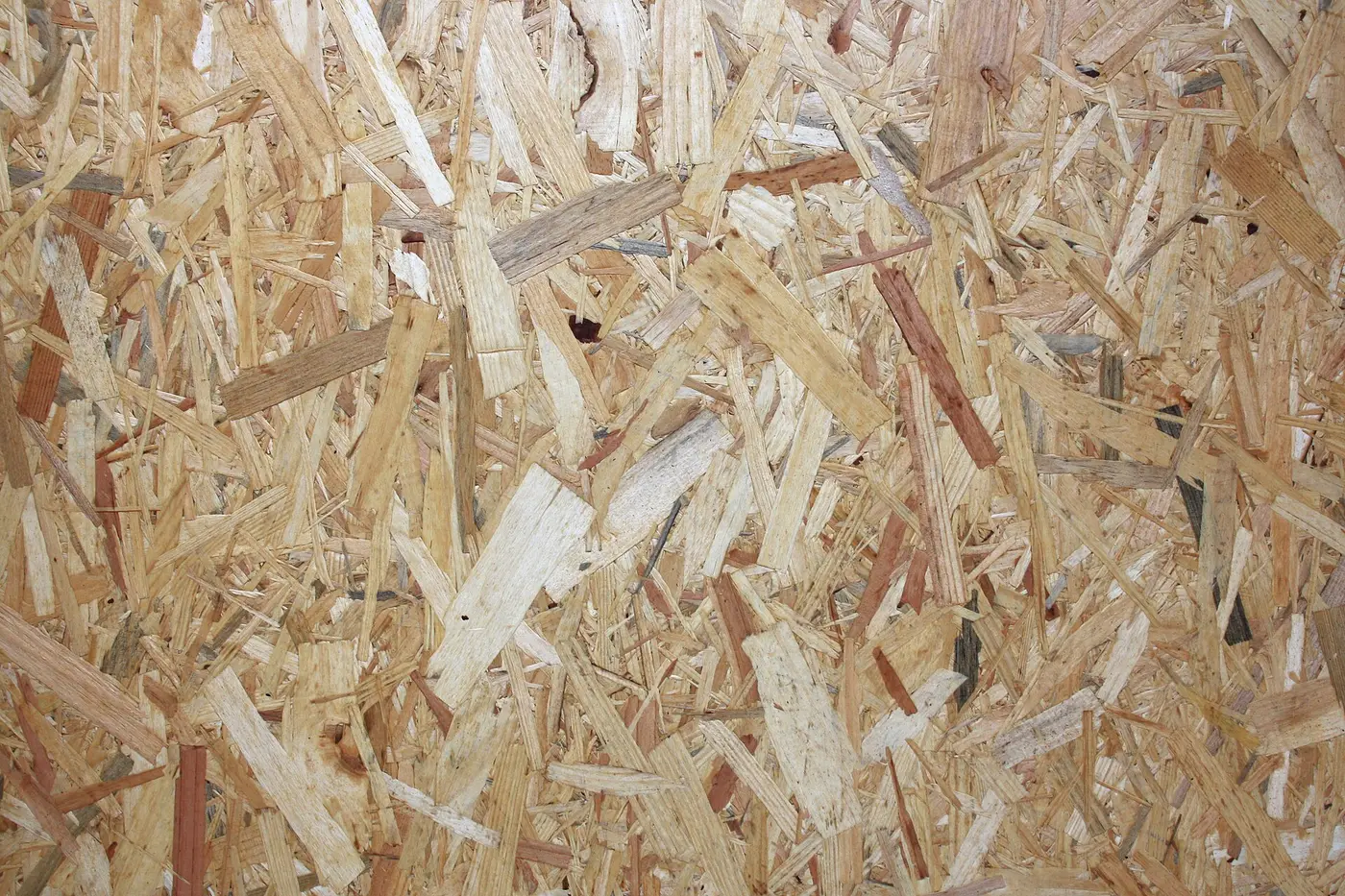
OSB has a distinctive look: large, flat wood strands pressed together in a coarse, irregular pattern. The surface is rough and textured, and the strands are visibly oriented in different directions.
That texture is functional, not cosmetic. OSB is generally intended to be covered by other materials — siding, roofing, flooring — rather than left exposed as a finished surface, although it sometimes appears as a deliberate design choice.
Where Is OSB Commonly Used?
- Wall and roof sheathing in buildings
- Subfloor panels
- Siding substrates and structural bracing
- Crates, packaging, and some budget furniture components
OSB is most at home in structural applications. In furniture and cabinets, it is far less common than plywood, MDF, or particle board.
Advantages
- High strength and stiffness for structural use
- Large panel sizes with good consistency
- Usually less expensive than plywood
- Makes use of smaller-diameter logs
- Good dimensional stability from oriented layers
Limitations
- Rough surface that is not intended for fine finishing
- Edges can swell when wet if not properly rated or sealed
- Usually heavier than comparable plywood
- Fastener holding and workability differ from plywood
- Visible strand texture is not desirable in most furniture
Is OSB Waterproof?
OSB should not be assumed to be waterproof. Panels are manufactured in different exposure ratings, and the adhesive and edge treatment decide how a panel behaves when wet. Rated sheathing panels can tolerate construction moisture, but prolonged saturation can swell the edges and reduce performance.
The manufacturer’s grade and specification take priority over the general name.
OSB vs Related Materials
OSB is built from strands, which sets it apart from plywood’s veneers and particle board’s particles. It is most often compared with plywood because both serve as structural panels.
See the direct comparison:
Common Mistakes
- Using OSB as a finished furniture surface
- Assuming all OSB is rated for exterior exposure
- Treating OSB and plywood as identical structural panels
- Ignoring edge swelling when panels are exposed during construction
References
See the References section for the sources used to write this page.