
Quick Answer
Particle board, also called chipboard or particleboard, is an engineered wood panel made by bonding wood particles and adhesive under heat and pressure. The particles are larger and coarser than the fibers in MDF, which gives the panel a lower density and a rougher raw surface. Particle board is most often used as a hidden core beneath a laminate or melamine surface in flat-pack furniture, cabinets, and shelving.
What Is Particle Board Made From?
Particle board begins with wood particles — chips, shavings, sawdust, and other small wood elements. These are mixed with a synthetic resin and formed into a mat, which is pressed under heat and pressure into a panel.
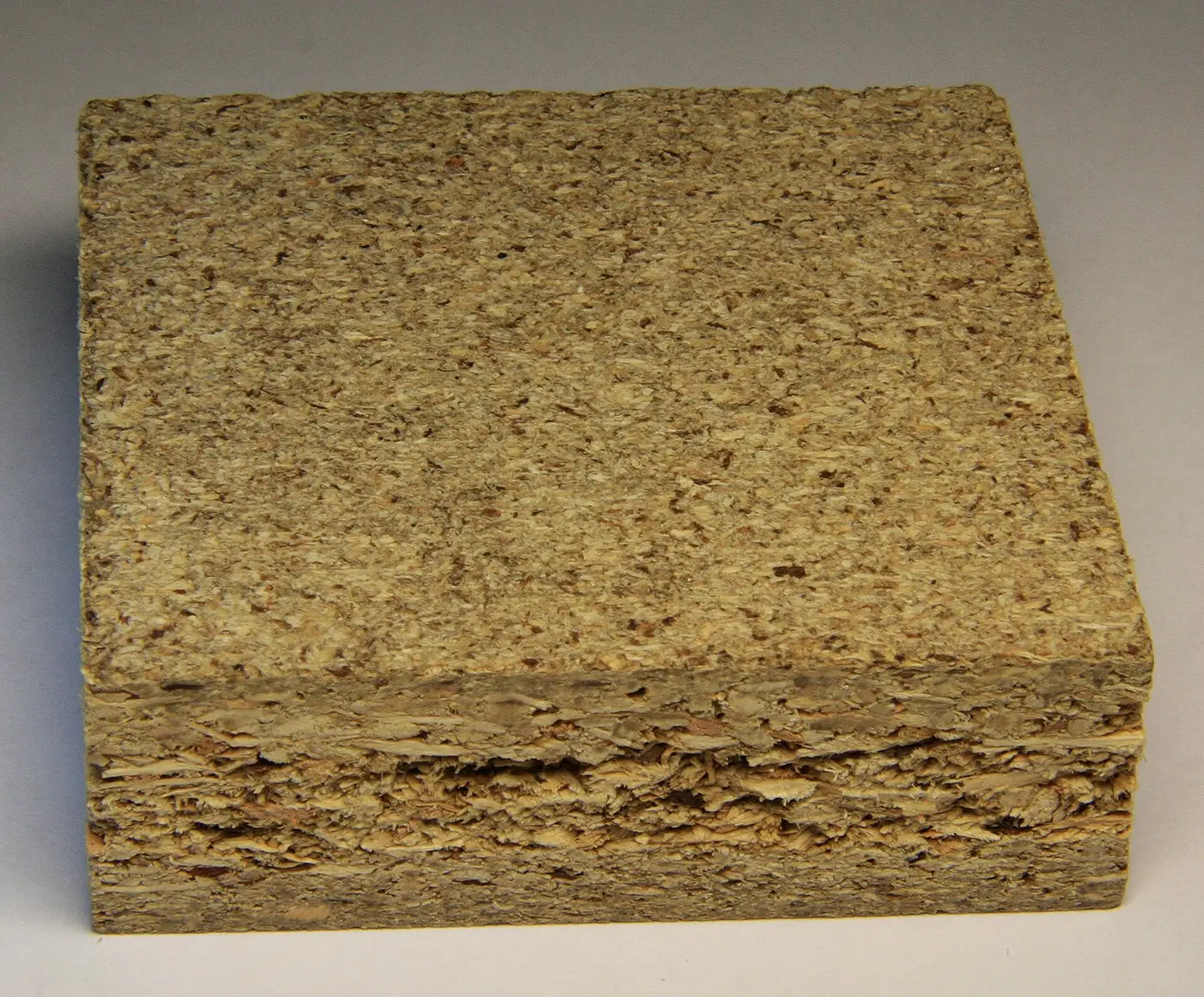
The size and distribution of the particles matter. In many panels, finer particles sit near the surface while coarser particles fill the middle, a layered arrangement that gives the board a smoother face and a lower-density core. Exact construction varies by grade and manufacturer.
Because particle board is built from particles rather than layers, it has no continuous grain and less structural strength than plywood of the same thickness. Its real value is cost and flatness as a substrate.
What Does Particle Board Look and Feel Like?
Unfinished particle board has a slightly rough, speckled surface that shows the individual particles. The edges are flaky and brittle, which is why finished furniture always covers them with edge banding or another treatment.
In finished products, you rarely see the raw board. A cabinet shelf or desk top described as particle board is almost always a particle board core covered with melamine, laminate, or veneer. What you see is the surface layer, not the core.
Where Is Particle Board Commonly Used?
- Flat-pack and budget furniture panels
- Cabinet carcasses and shelving
- Wardrobe and closet components
- Desk and table tops beneath a laminate surface
- Wall and flooring substrates
It is generally an indoor material. Standard particle board is not intended for sustained moisture exposure.
Advantages
- Low cost compared with plywood and solid wood
- Flat, stable panels with consistent thickness
- Smooth enough for laminate and melamine surfaces
- Uses wood particles that might otherwise be waste
- Widely available in large sheet sizes
Limitations
- Weaker screw holding, especially near panel edges
- Standard grades swell and weaken when saturated
- Rough, brittle edges that require banding
- Heavier than some plywood for the same size
- Less suited to routed details than MDF
Is Particle Board Waterproof?
Standard particle board should not be assumed to be waterproof. If the core becomes saturated, the particles can swell and the panel can lose strength. Moisture-resistant grades are available for specific applications, and their performance depends on the product specification.
The finished surface also matters. A laminate or melamine face sheds water far better than raw particle board, but water that reaches the edges or unsealed cuts can still enter the core.
Particle Board vs Related Materials
Particle board is most often confused with MDF and plywood. MDF is made from finer fibers and is denser and smoother. Plywood is made from cross-laminated veneers and holds screws better. Particle board sits between them as the economical core material.
See the direct comparisons:
Common Mistakes
- Calling any white furniture panel “particle board” when it may be MDF
- Assuming all particle board is low quality regardless of grade
- Expecting raw particle board edges to survive without banding
- Treating a water-resistant surface as a waterproof core
References
See the References section for the sources used to write this page.