
Quick Answer
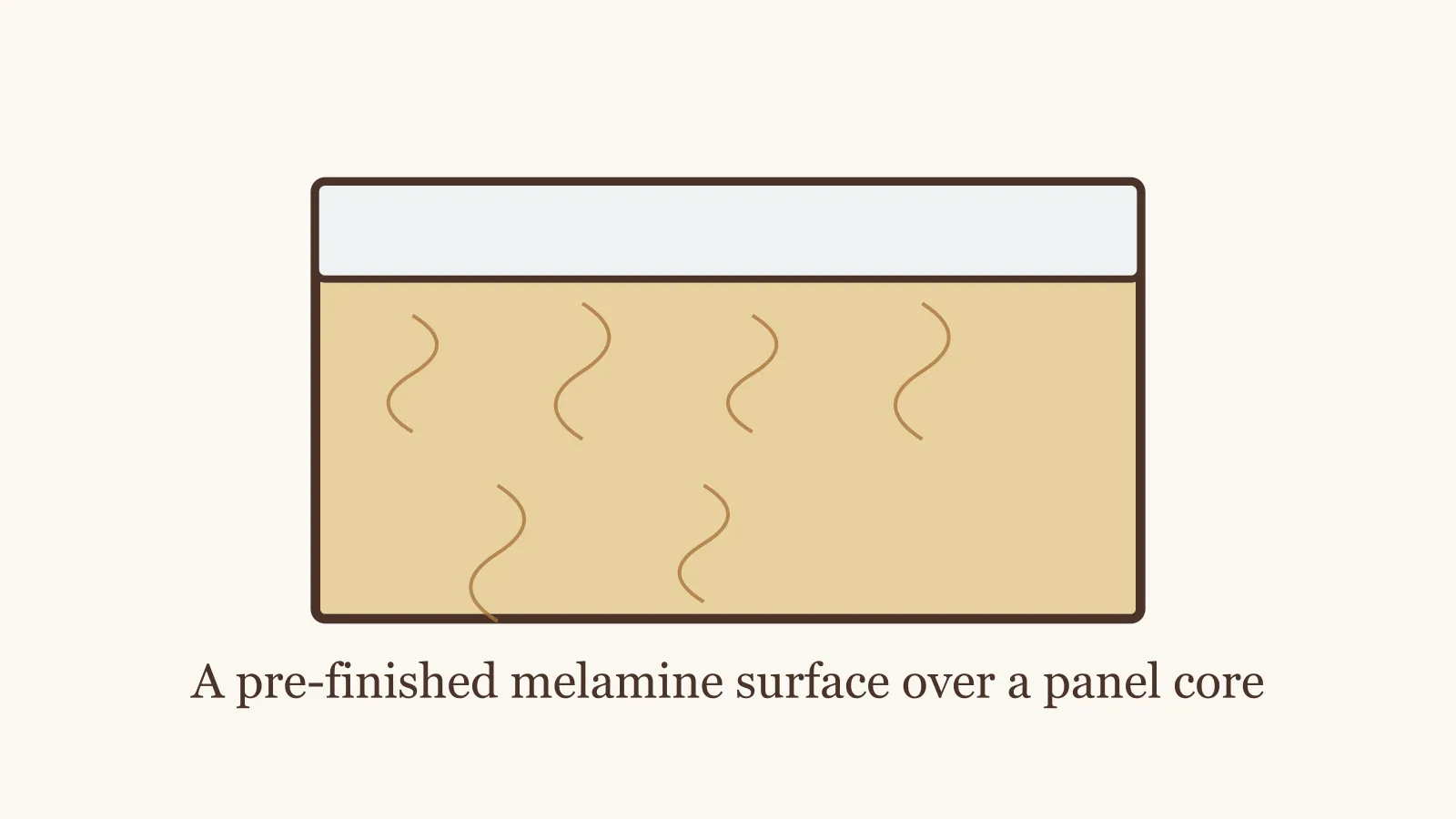
Melamine board, also called melamine faced board, is a panel — usually particle board or MDF — with a decorative paper layer impregnated with melamine resin fused directly to its surfaces. The result is a hard, smooth, low-maintenance panel that arrives pre-finished. It is used throughout cabinet and furniture making for shelves, carcasses, and wardrobe panels.
How Is Melamine Board Made?
Melamine board starts with a core panel, typically particle board or MDF. Decorative paper, saturated with melamine resin, is placed on the surfaces and pressed under heat so that the resin melts and bonds the paper to the core. The surface is formed in the same press cycle, which is why it is sometimes called thermally fused melamine.
Because the surface is fused rather than glued on as a separate sheet, it is thin, hard, and well bonded to the core. The core does the structural work; the melamine surface provides the finished look and easy cleaning.
The core grade and the surface thickness both vary by product. A melamine board built on moisture-resistant particle board is different from one built on standard board.
What Does Melamine Board Look Like?
Melamine board usually has a smooth, slightly glossy or matte surface in a solid color — white is common — or a printed pattern. The edges show the core, which is why cut panels are edge-banded: the raw edge would otherwise expose the particle board or MDF beneath.
Where Is Melamine Board Commonly Used?
- Cabinet carcasses and shelves
- Wardrobe and closet panels
- Furniture panels and drawer components
- Office furniture and desktops
- Interior fit-outs
It is the workhorse of budget and mid-range cabinetry because it arrives finished and is fast to work with.
Advantages
- Pre-finished surface that needs no painting
- Hard, smooth, and easy to clean
- Wide range of solid colors and patterns
- Cost-effective for cabinet interiors
- Consistent appearance across panels
Limitations
- Cut edges must be banded
- Surface cannot be refinished
- Chips at edges are hard to repair invisibly
- Core quality varies by grade
- Moisture resistance depends on the core, not just the surface
Is Melamine Board Waterproof?
The melamine surface resists moisture well, but the panel as a whole is not automatically waterproof. Water reaching a cut edge or the core can cause swelling, especially in standard particle board cores. Moisture-resistant core grades exist, and their performance depends on the product specification.
Melamine vs Laminate
Melamine board and laminate are related but not the same. Laminate is a thicker sheet that is bonded onto a core afterward; melamine is a thinner resin-impregnated paper fused to the core during pressing. Both are manufactured surfaces, and both are different from wood veneer.
See related pages:
Common Mistakes
- Calling any white panel “melamine” regardless of the actual surface
- Assuming the melamine surface makes the whole panel waterproof
- Skipping edge banding on cut edges
- Treating melamine board and laminate sheet as the same product
References
See the References section for the sources used to write this page.