
Quick Answer
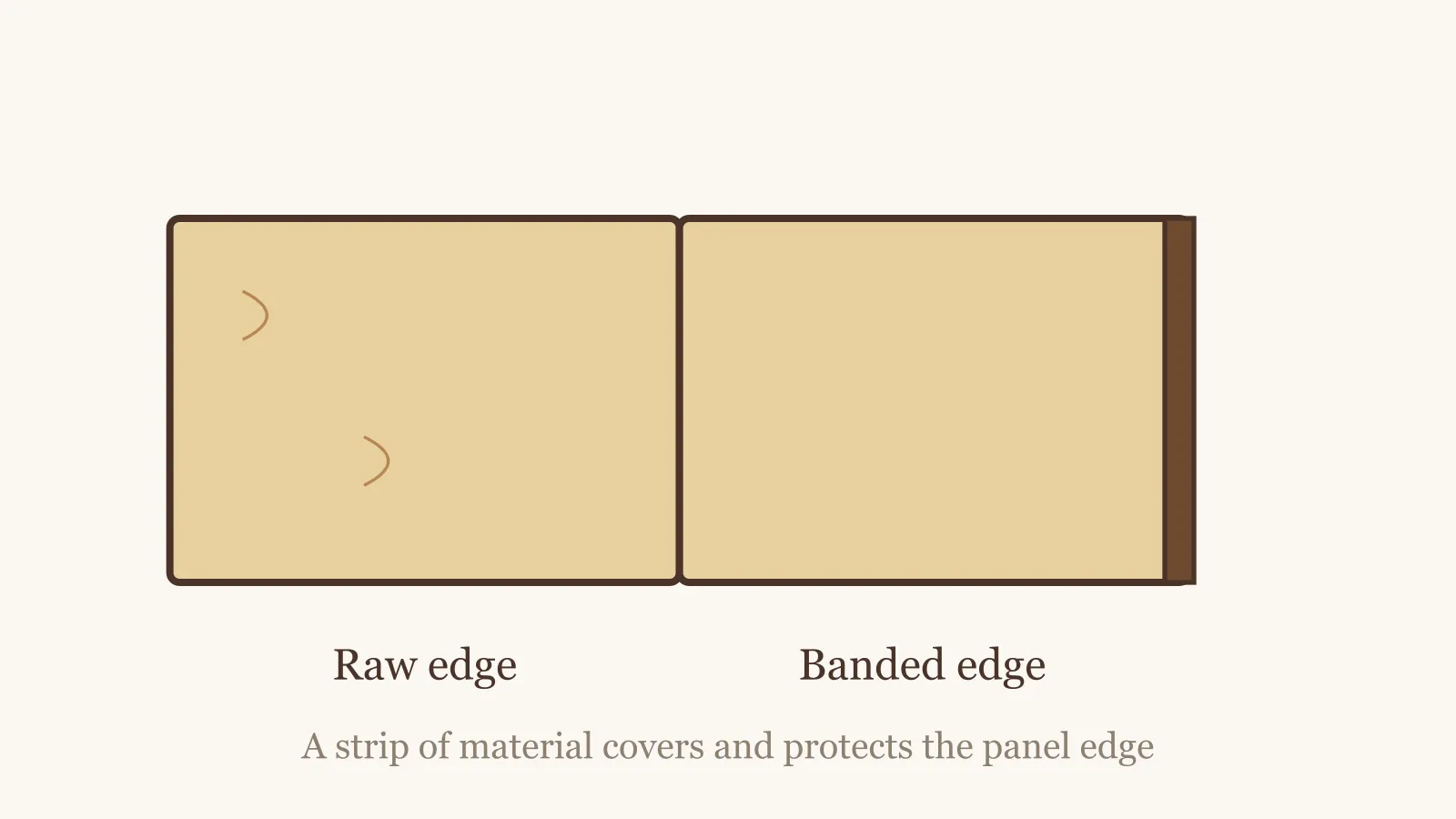
Edge banding is a strip of material applied to the cut edge of a panel to cover the exposed core and protect it. Because boards such as particle board, MDF, and plywood have rough, absorbent, or layered edges, banding gives the panel a clean, finished look and seals the edge against moisture and damage. It is standard on nearly all modern panel furniture.
Why Panels Need Edge Banding
Engineered panels are finished on their faces but not on their edges. Cut a melamine-faced particle board and the edge exposes the particle core — rough, porous, and ugly. Cut plywood and the edge shows the layered veneers.
Edge banding solves that. A thin strip — commonly PVC, ABS, melamine, or wood veneer — is glued to the edge, then trimmed flush with the faces. The result looks like a solid, finished panel rather than a raw cut.
What Edge Banding Does
- Covers the exposed core for a clean appearance
- Seals the edge against moisture entry
- Protects the edge from chips and damage
- Matches or contrasts with the surface finish
- Provides a surface that can be rounded or profiled
Common Edge Banding Materials
- PVC and ABS, common on melamine and laminate panels
- Wood veneer banding, used when the faces are veneered
- Melamine banding, pre-finished to match the surface
- Solid wood edging, used on veneered and higher-end panels
The banding material is usually chosen to match the face, so a white melamine shelf gets a white banded edge that disappears visually.
Where Edge Banding Is Used
- Cabinet doors, shelves, and carcass panels
- Desks, tabletops, and flat-pack furniture
- Wardrobe and closet panels
- Any engineered panel with a visible cut edge
Advantages
- Clean, finished appearance on every edge
- Protects edges from moisture and impact
- Available in many colors and materials
- Inexpensive compared with solid wood edging
- Fast to apply with modern edge banding machines
Limitations
- Banding can peel or chip if poorly applied
- The glue line can be visible on close inspection
- Very thin banding offers little impact protection
- Banding cannot hide a poorly cut or damaged edge
- Heat and moisture can loosen some banding over time
Common Mistakes
- Assuming a banded edge means the panel is solid wood
- Confusing edge banding with the panel surface material
- Judging a cabinet’s durability without checking the banding quality
- Expecting thin banding to repair a swollen or damaged edge
References
See the References section for the sources used to write this page.