
Quick Difference
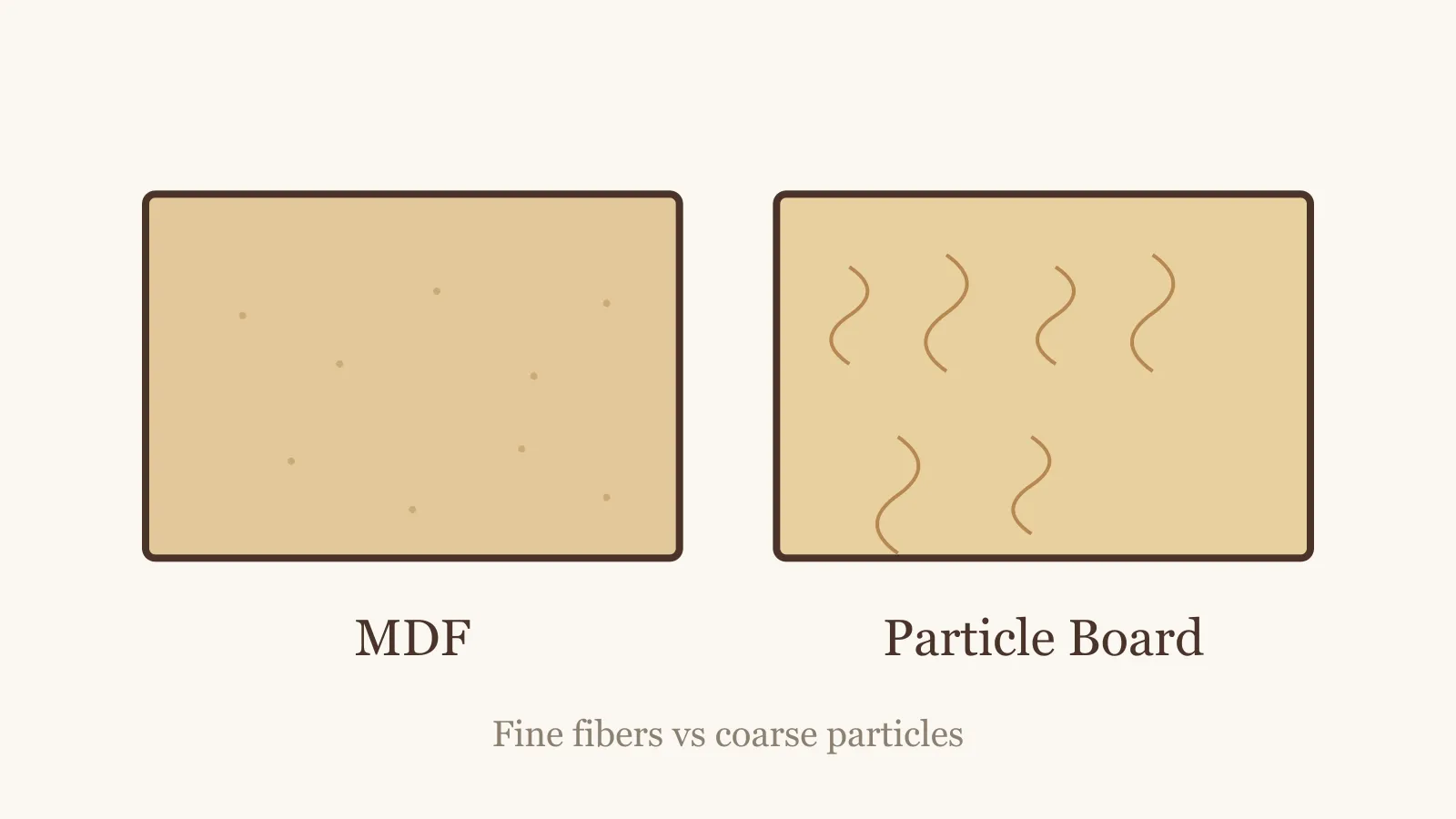
MDF and particle board are both engineered panels made from wood and resin, but the size of the wood element is different. MDF is made from fine fibers and is denser, smoother, and more uniform. Particle board is made from coarser particles and is lighter, cheaper, and rougher. In practice, MDF is preferred where smooth painted or routed surfaces matter, while particle board is preferred as an economical core under laminate or melamine.
What Is MDF?
MDF is a fiberboard pressed from refined wood fibers. Its core is dense and uniform, with no visible particles, and it has a smooth surface that paints well. See What Is MDF?.
What Is Particle Board?
Particle board is a panel pressed from wood particles and adhesive. It has a coarser, lower-density core and a rough raw surface, so it is almost always used under a laminate or melamine face. See What Is Particle Board?.
Construction and Density
The key difference is element size. MDF’s fine fibers pack tightly into a dense, even panel. Particle board’s larger particles leave more voids, making the panel lighter and less dense. That density difference shows up in strength, screw holding, and how each board behaves when cut or machined.
Surface
MDF has a smooth, grain-free surface that paints evenly and accepts routed edges cleanly. Particle board’s raw surface is rough and speckled, so it depends on its laminate or melamine face for appearance.
Screw Holding
MDF holds screws better than particle board, particularly in the face. Particle board’s screw holding is weaker, especially at edges, which is why assembly hardware in flat-pack furniture is designed around its limits.
Moisture Performance
Neither standard product is waterproof. Standard particle board tends to swell more noticeably when saturated. Both are available in moisture-resistant grades, and the product specification decides the actual performance.
Cost
Particle board is usually the cheaper of the two, which is why it is the default core for budget and flat-pack furniture. MDF costs more but delivers a smoother, denser panel.
Machining
MDF machines cleanly and takes routed profiles and shaped edges well. Particle board is less suited to fine routing because its coarse core can crumble at the edges.
Typical Uses
MDF suits painted panels, profiled doors, and trim. Particle board suits cabinet carcasses, shelving, and furniture cores under a laminate or melamine surface.
Which Is Better for Painted Furniture?
MDF is the better choice for painted furniture. Its smooth, grain-free face produces a clean paint finish without grain or particle texture showing through.
Which Is Better for Flat-Pack Furniture?
Particle board is the more common core for flat-pack furniture because of cost and weight. Its lower screw holding is managed through the hardware design.
Which Is More Durable?
MDF is generally denser and more resistant to dents, but durability also depends on the surface finish and the environment. A melamine-faced particle board can be very serviceable in a dry interior.
Which Should You Choose?
Choose MDF for smooth painted surfaces, routed details, and denser panels. Choose particle board for economical cores under laminate or melamine, where the surface layer does the visible work. The two are often used together in the same piece of furniture.
References
See the References section for the sources used to write this page.