
Quick Answer
Engineered wood is an umbrella term, not a single material. It covers any wood product manufactured from wood elements — fibers, particles, strands, veneers, or laminations — that are bonded together with adhesive. MDF, plywood, particle board, OSB, and HDF are all engineered wood, and each is made differently and performs differently.
What Counts as Engineered Wood?
The category is broad because the manufacturing methods are broad. Some engineered products break wood down to fibers, as MDF does. Others use particles, as particle board does, or large strands, as OSB does. Still others reassemble thin veneers, as plywood does, or bond wood strips into larger members.
The common thread is that the wood is processed and re-bonded rather than used as a single sawn board. That processing is what allows engineered products to be made in large, consistent sheets and to use wood that would be difficult to use as solid lumber.
How Is Engineered Wood Made?
There is no single process. The general pattern is:
- Wood is broken down into the required element — fibers, particles, strands, or veneers.
- The elements are combined with an adhesive or resin.
- The mixture or stack is pressed under heat and pressure into a panel or shape.
The adhesive system, the element size, and the layering all change the result. That is why two engineered panels with the same dimensions can behave very differently.
What Does Engineered Wood Look Like?
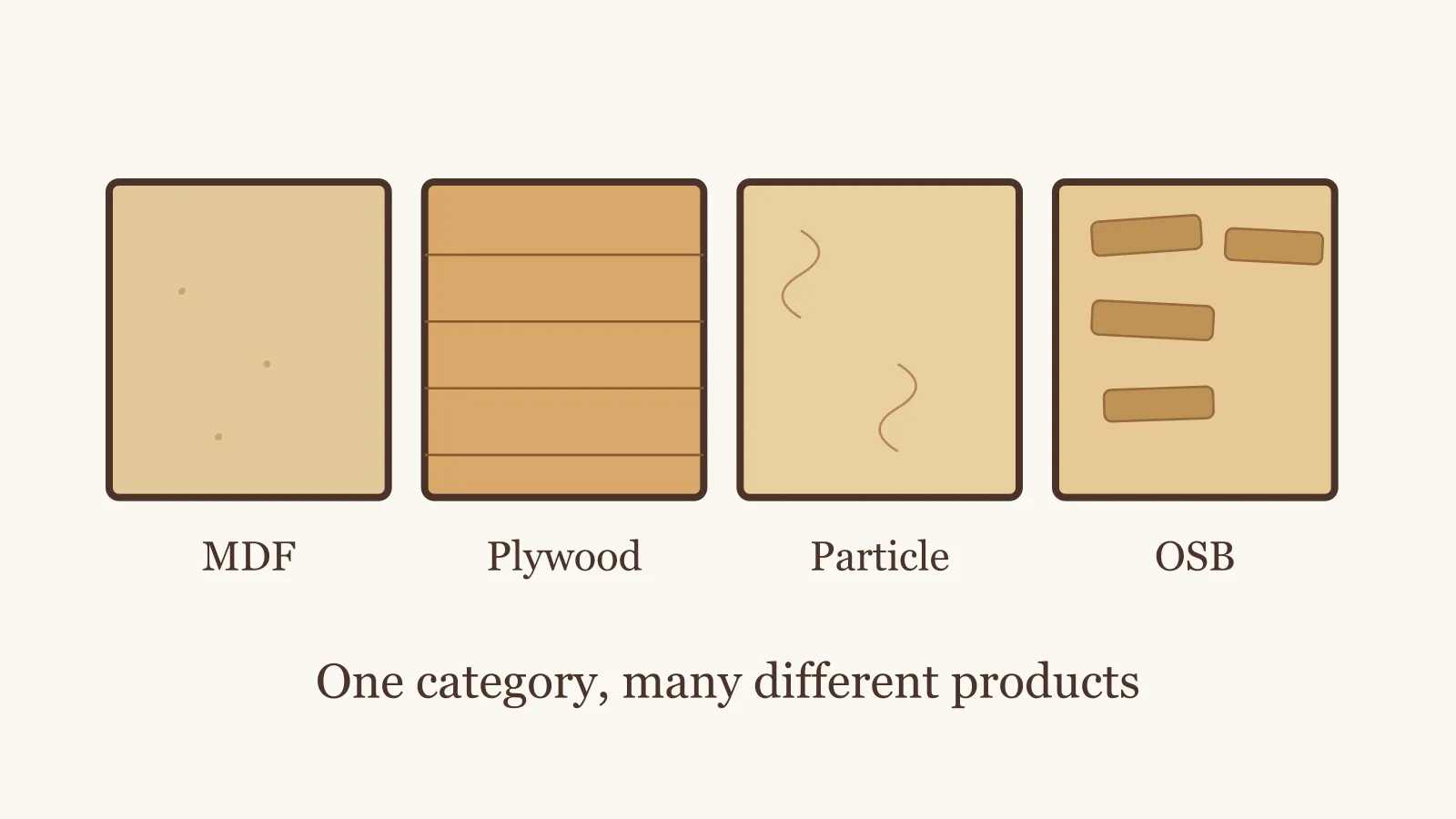
It depends entirely on the product. MDF is smooth and uniform. Plywood shows a layered edge. Particle board has a speckled, particle-filled surface. OSB shows large oriented strands. The category has no single appearance, which is exactly why the general term can be misleading.
Where Is Engineered Wood Commonly Used?
- Furniture and cabinetry
- Flooring underlayment and cores
- Wall, roof, and floor sheathing
- Doors, shelving, and interior panels
- Structural beams and lumber substitutes
Different products serve different jobs. OSB is structural; MDF is not. Plywood holds screws; particle board holds them less well.
Advantages
- Large, consistent panel sizes
- Efficient use of wood fiber
- Often more dimensionally stable than solid wood
- Usually more affordable than solid lumber
- Product range covers many different needs
Limitations
- Performance varies enormously across the category
- Many products are sensitive to moisture without the right grade
- Adhesives and additives differ by product and grade
- Edge treatment is often required
- The general term can hide important differences
Is Engineered Wood Waterproof?
No single answer is possible. Some engineered products are made in moisture-resistant or exterior grades; others are strictly for dry interior use. The specific product, its adhesive, and its rating decide moisture performance, not the umbrella term.
Engineered Wood vs Solid Wood
Engineered wood is often compared with solid wood, but the comparison only makes sense product by product. A veneered plywood panel and a solid oak board are different materials with different strengths.
See the direct comparison:
And the individual product pages:
Common Mistakes
- Treating engineered wood as one material with one set of properties
- Assuming all engineered panels are equally moisture resistant
- Comparing “engineered wood” to solid wood without naming the product
- Ignoring grade, adhesive, and construction when judging quality
References
See the References section for the sources used to write this page.