
Quick Difference
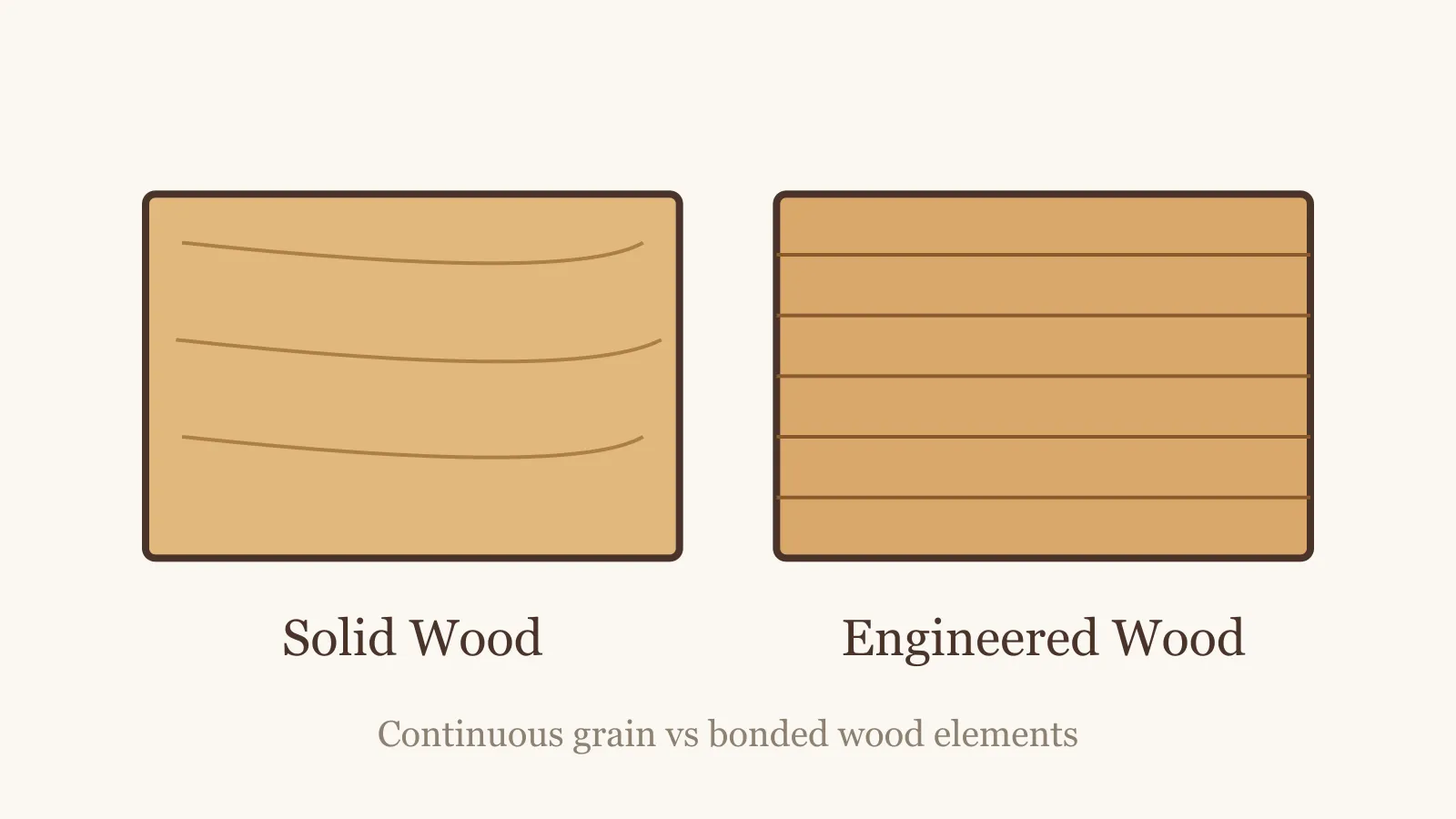
Solid wood is lumber cut directly from a tree and used as a single piece, with continuous grain. Engineered wood is a broad category of products built from wood fibers, particles, strands, or veneers bonded together. Solid wood can usually be refinished and repaired but moves with humidity; engineered panels are often more stable and affordable but their surface and performance depend on the specific product.
What Is Solid Wood?
Solid wood is a single sawn board. Its grain runs through the piece, it can usually be sanded and refinished, and it moves as humidity changes. See What Is Solid Wood?.
What Is Engineered Wood?
Engineered wood is an umbrella term covering products such as MDF, plywood, particle board, OSB, and HDF. They are manufactured from wood elements and bonded with adhesive, and each product behaves differently. See What Is Engineered Wood?.
Construction and Movement
Solid wood’s fibers all run one way, so the board expands and shrinks across the grain with seasonal humidity. Engineered panels usually cross or randomize the wood elements, which makes them more dimensionally stable. That stability is one of the main reasons engineered panels exist.
Refinishing and Repair
Solid wood can generally be sanded and refinished many times, and many defects can be repaired. Engineered wood depends on its surface: a solid wood veneer can be lightly refinished, but laminate and melamine cannot. Repair options are more limited once an engineered panel is damaged.
Cost
Solid wood is usually more expensive, especially in furniture-sized pieces. Engineered panels make large, stable surfaces affordable and use wood fiber efficiently.
Appearance
Solid wood shows real grain through the board, with natural variation. Engineered panels range from smooth and uniform (MDF) to wood-faced (veneer) to printed patterns (laminate). The “look” depends entirely on the product.
Typical Uses
Solid wood is used for table tops, chair frames, doors, and high-wear parts that may be refinished. Engineered wood is used for cabinet carcasses, shelving, panel surfaces, and structural sheathing — often in the same piece of furniture as solid wood.
Which Is Better?
Neither is universally better. Solid wood is preferable where refinishing, repair, and natural movement are acceptable. Engineered panels are preferable where stability, cost, and large flat surfaces matter. The comparison only becomes meaningful when the specific engineered product is named.
Which Should You Choose?
Choose solid wood for heirloom furniture, visible frames, and surfaces you may refinish. Choose engineered wood for stable panels, cabinet boxes, and budget-friendly large surfaces. A well-made piece frequently combines both.
References
See the References section for the sources used to write this page.