
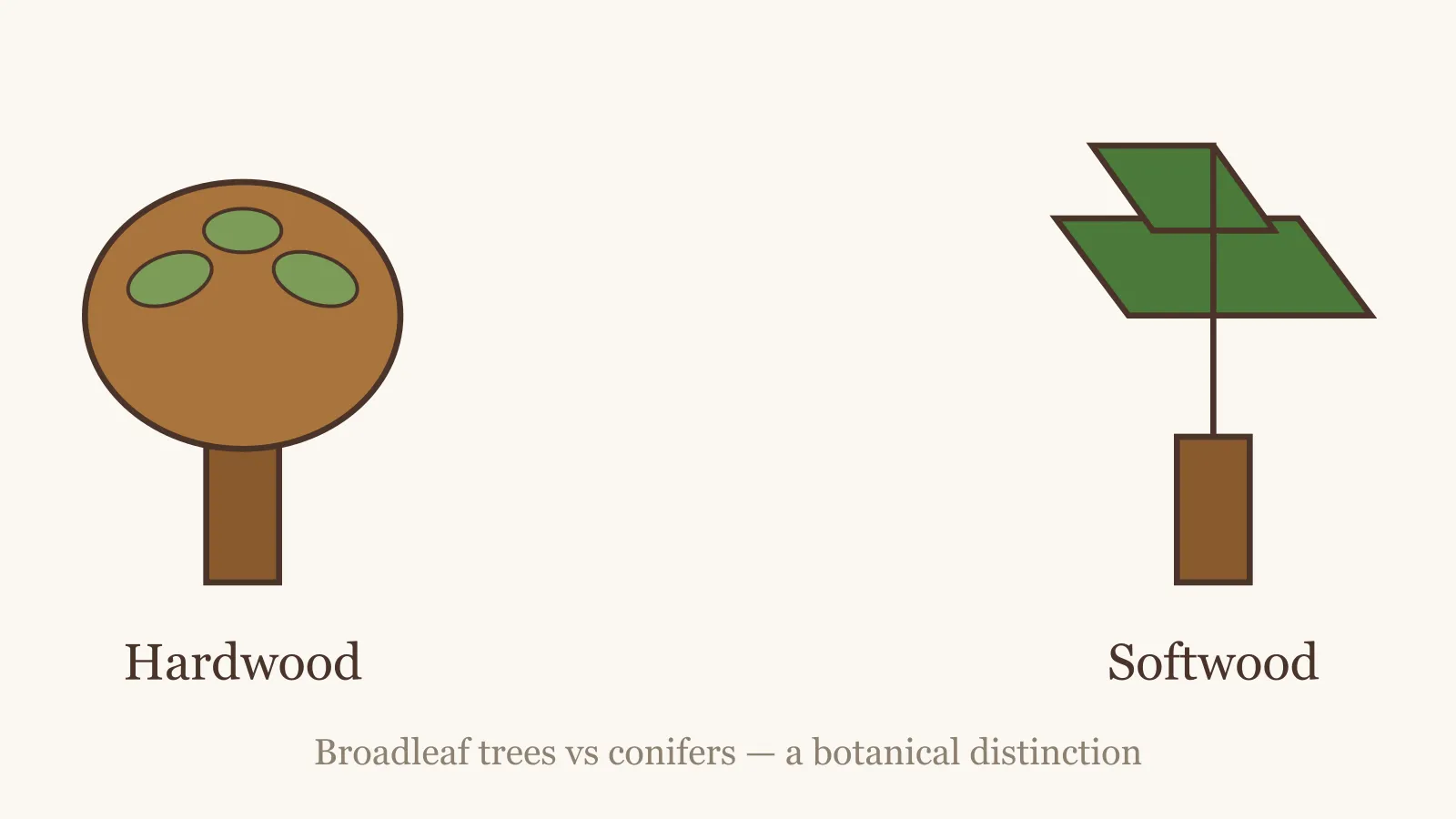
Quick Difference
Hardwood and softwood describe botanical groups, not two performance grades. Hardwoods come from angiosperm trees such as oak, maple, and balsa. Softwoods come from gymnosperms such as pine, spruce, fir, and cedar. The species, grade, moisture condition, and grain tell you much more about a board’s suitability than the category alone.
An oak tabletop, a pine cabinet, and a cedar outdoor component can each be sensible choices. The question is which properties the part needs, not which group sounds more durable.
What the Names Identify
The distinction comes from tree biology and wood structure. Angiosperms produce seeds enclosed in fruit; gymnosperms have unenclosed seeds, commonly carried in cones. Common commercial hardwoods are broadleaf trees, while common commercial softwoods are conifers. Leaf shedding and evergreen appearance are not reliable tests: there are evergreen hardwoods and deciduous conifers.
Under magnification, most hardwoods have vessels that appear as pores in end grain. Softwoods generally lack those vessels and have a different arrangement of conducting cells. That is more useful for identification than assuming dark wood is hardwood and pale wood is softwood.
Hardness, Strength, and Decay Resistance Are Separate
Hardness concerns resistance to indentation. A tabletop exposed to dropped objects may benefit from an appropriately hard species, but a category label does not provide a hardness value. Balsa is a hardwood yet is very light and soft.
Strength and stiffness concern different ways of resisting forces and deformation. They depend on species, grain direction, defects, member dimensions, moisture, and grading. A hard surface is not proof that a long shelf will resist sag or that a board is suitable as a beam.
Decay resistance concerns biological attack under suitable moisture conditions. It varies by species and by heartwood versus sapwood. Many hardwoods are unsuitable for unprotected exterior service, while some softwood heartwoods are used outdoors. Treatment, detailing, and keeping water from accumulating can be more important than the group name.
Choose by the Part You Are Making
| Part | Useful properties to investigate | Why the category is insufficient |
|---|---|---|
| Dining tabletop | Indentation resistance, grain, movement and finish | Some hardwoods dent readily; all solid tops need movement allowance |
| Painted cabinet or trim | Straightness, machining, resin or knot behavior | Either group can work with suitable preparation |
| Furniture rail or leg | Straight grain, defects, joint design and dimensions | Hardness alone does not predict joint performance |
| Exterior component | Durability of the actual species or treatment | Hardwood does not mean rot-proof |
| Structural member | Recognized species/grade and design values | Furniture descriptions are not structural grades |
For structural work, follow the specified species group, grade, dimensions, and applicable design information. Do not substitute a board merely because its name includes hardwood.
Appearance and Finishing
Hardwood grain ranges from pronounced open pores to fine, relatively even texture. Softwoods also vary, and earlywood-to-latewood contrast can affect machining and staining. A general promise of a smoother hardwood finish is therefore misleading.
Inspect a sample of the actual species and cut. Test sanding, staining, and the finish together. Knots, resin, surface contamination, and uneven absorption can affect the result more than the hardwood/softwood distinction. A clear coating also changes color and contrast, so compare finished samples rather than raw photographs.
Buying Lumber More Precisely
Ask for the species, intended use, actual dimensions, moisture condition, and grading system. Hardwood and softwood lumber may be sold under different grading and sizing conventions; one grade name should not be interpreted through the other system.
Inspect for twist, bow, checks, knots, and grain runout at critical joints. A clear but badly twisted board may produce less usable material than a straighter board with a defect you can cut around. Plan the parts before assuming that a more expensive category will reduce waste.
Finally, consider wood moisture content. Both groups exchange moisture with the surrounding air. Proper drying, acclimation, and movement-aware construction remain necessary even when a species is marketed as premium furniture wood.
References
The wood-science sources below describe botanical identification, physical properties, and moisture behavior. Compare species-specific data when making a performance decision.