
Quick Answer
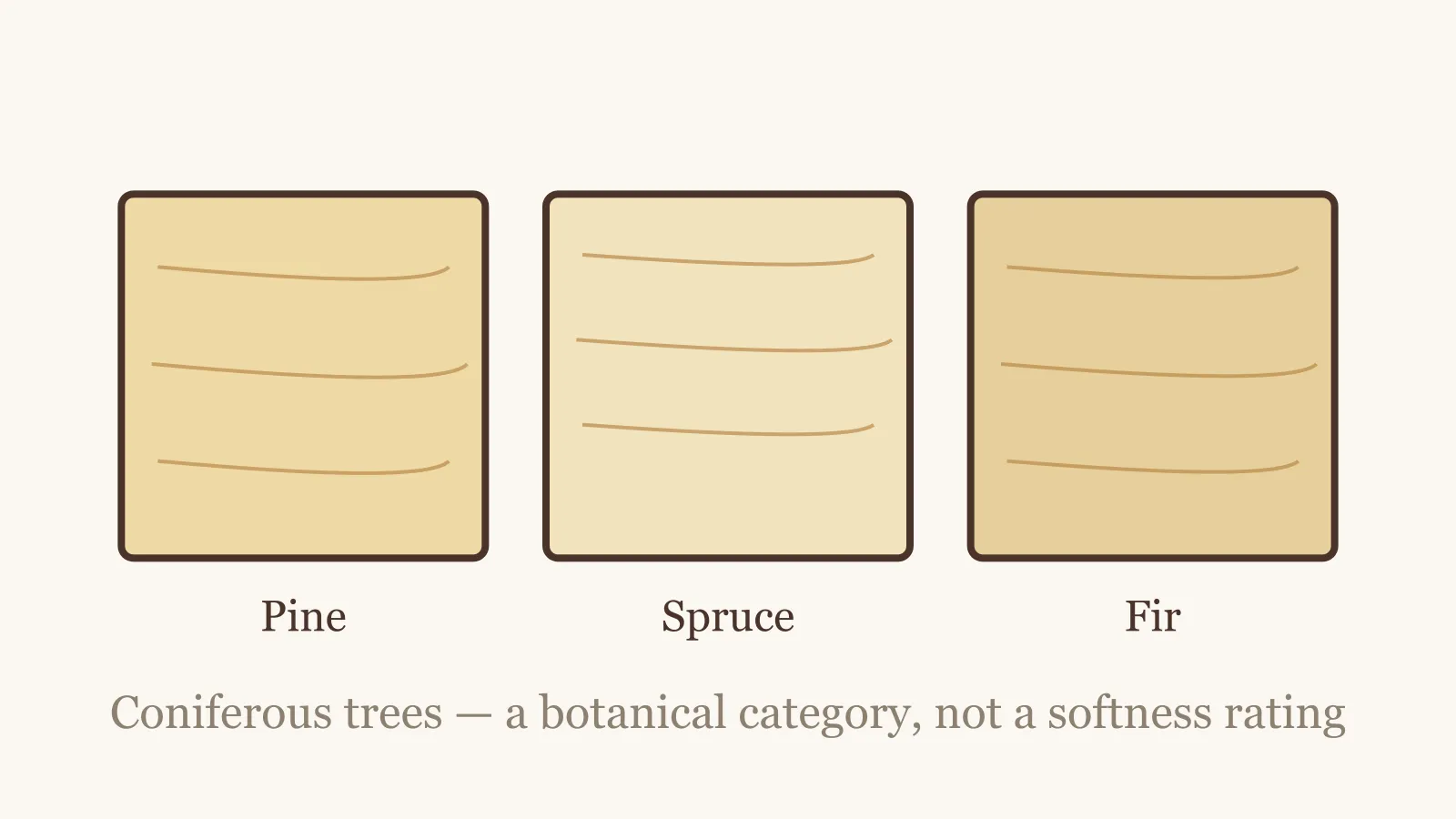
Softwood is a botanical term for wood from coniferous, cone-bearing trees — the gymnosperms — such as pine, spruce, fir, and cedar. It is a classification of the tree’s biology, not a rating of how soft the wood is. Some softwoods are quite dense, and the name should not be read as a weakness or softness guarantee.
What Makes a Wood a Softwood?
The distinction is about the tree. Softwoods come from gymnosperms: trees that bear cones and usually have needle-like or scale-like leaves. Many are evergreen and keep their foliage year-round, although some, such as larch, are deciduous.
Common softwood species include pine, spruce, fir, cedar, hemlock, and larch. Softwoods dominate construction timber, but they also appear in furniture, trim, and doors.
As with hardwoods, the category describes botany. It does not describe how soft the board feels.
Why “Softwood” Is Misleading
The name invites the opposite mistake to hardwood: assuming softwood is soft wood. Some softwoods are denser and harder than some hardwoods. Yew, a softwood, is famously hard and dense, while balsa, a hardwood, is extremely light.
A listing that says “softwood” without naming a species tells you little about strength or suitability. Pine and cedar are both softwoods, but they are used very differently.
What Does Softwood Look Like?
Softwood appearance varies by species. Pine is pale with prominent growth rings, spruce is light and even, and cedar has a warm reddish tone and distinctive scent. Because the species differ, there is no single “softwood look.”
Where Is Softwood Commonly Used?
- Framing and structural timber
- Trim, baseboards, and doors
- Budget and painted furniture
- Paneling and cladding
- Paper and engineered wood feedstock
Softwoods also feed many engineered products. The wood in MDF, particle board, and OSB is often softwood, because softwoods are fast-growing and widely available.
Advantages
- Fast-growing and widely available
- Usually less expensive than hardwoods
- Easy to cut and fasten
- Light weight for many uses
- Renewable supply when managed well
Limitations
- The label alone does not guarantee softness or weakness
- Many species dent and mark more easily than hardwoods
- Generally less suited to high-wear surfaces
- Resin in some species can affect finishing
- Durability outdoors varies by species and treatment
Softwood vs Hardwood
Softwood and hardwood are the two broad botanical groups. The difference is the tree’s biology — gymnosperm versus angiosperm — not a simple soft-versus-hard comparison.
See the direct comparison:
Common Mistakes
- Assuming softwood is always softer than hardwood
- Dismissing softwood as low quality without naming the species
- Using untreated softwood outdoors and expecting durability
- Confusing the botanical category with a quality grade
References
See the References section for the sources used to write this page.