
Quick Answer
Wood is hygroscopic: it exchanges water vapor with the surrounding air. A dry board placed in a humid room gains moisture; a wetter board placed in a dry, heated room loses it. Below the fiber-saturation region, those changes also make the board shrink or swell. That is why moisture content matters before milling, gluing, finishing, installing flooring, or building a wide solid-wood panel.
The goal is not to chase one universal “correct” percentage. The useful target is a moisture content close to the conditions in which the finished object will spend most of its time.
What Moisture Content Measures
Moisture content is calculated against the wood’s oven-dry mass:
moisture content = mass of water ÷ oven-dry mass × 100
Because the dry wood is the reference, freshly cut wood can have a moisture content above 100%. That does not mean the board is more than entirely water; it means the mass of water is greater than the mass of the dry wood substance.
Water exists in wood in two practical forms. Free water occupies cell cavities. Bound water is held within the cell walls. Removing free water changes weight significantly but has comparatively little effect on dimensions. Once drying moves below the fiber-saturation region, removing bound water causes the cell walls—and therefore the board—to shrink.
Why Wood Moves
Wood does not change equally in every direction. Lengthwise movement is usually small enough to ignore in ordinary furniture work. Movement across the board is the important part, and tangential movement—along the curve of the growth rings—is normally greater than radial movement across those rings.
That difference explains several familiar effects:
- a wide board may cup as its moisture content changes;
- a frame-and-panel door allows the panel to float inside the frame;
- table tops are fastened so they can move across their width;
- quarter-sawn boards tend to change less across their wide face than plain-sawn boards.
Read Plain-Sawn vs Quarter-Sawn Wood for the connection between growth-ring orientation and movement.
Equilibrium Moisture Content
Given enough time, wood approaches an equilibrium moisture content (EMC) with the temperature and relative humidity around it. EMC is a moving target, not a permanent state. Heating a home in winter may dry the indoor air; an open coastal building may stay much more humid; air conditioning can lower interior moisture in a humid climate.
This is why acclimation means more than leaving boards in a room for a fixed number of days. Thick stock changes slowly, end grain changes faster than the middle, and a tightly wrapped stack exchanges little air. The useful question is whether readings have stabilized near the expected service condition—not whether a calendar interval has passed.
What Number Should Furniture Wood Be?
There is no single percentage that suits every location. Interior furniture in a climate-controlled building is usually prepared drier than exterior joinery or lumber for an unconditioned outbuilding. A board that is stable in a humid workshop may still shrink after it enters a heated home.
Use these principles instead of a universal target:
- Measure representative wood already living successfully in the destination environment when possible.
- Compare the new stock with that reference rather than relying on one generic number.
- Check several boards and several locations on wide or thick stock.
- Allow extra time when the center and surface readings disagree.
- Treat a structural, flooring, or manufacturer specification as more authoritative than a general guide.
Pin and Pinless Moisture Meters
Pin meters
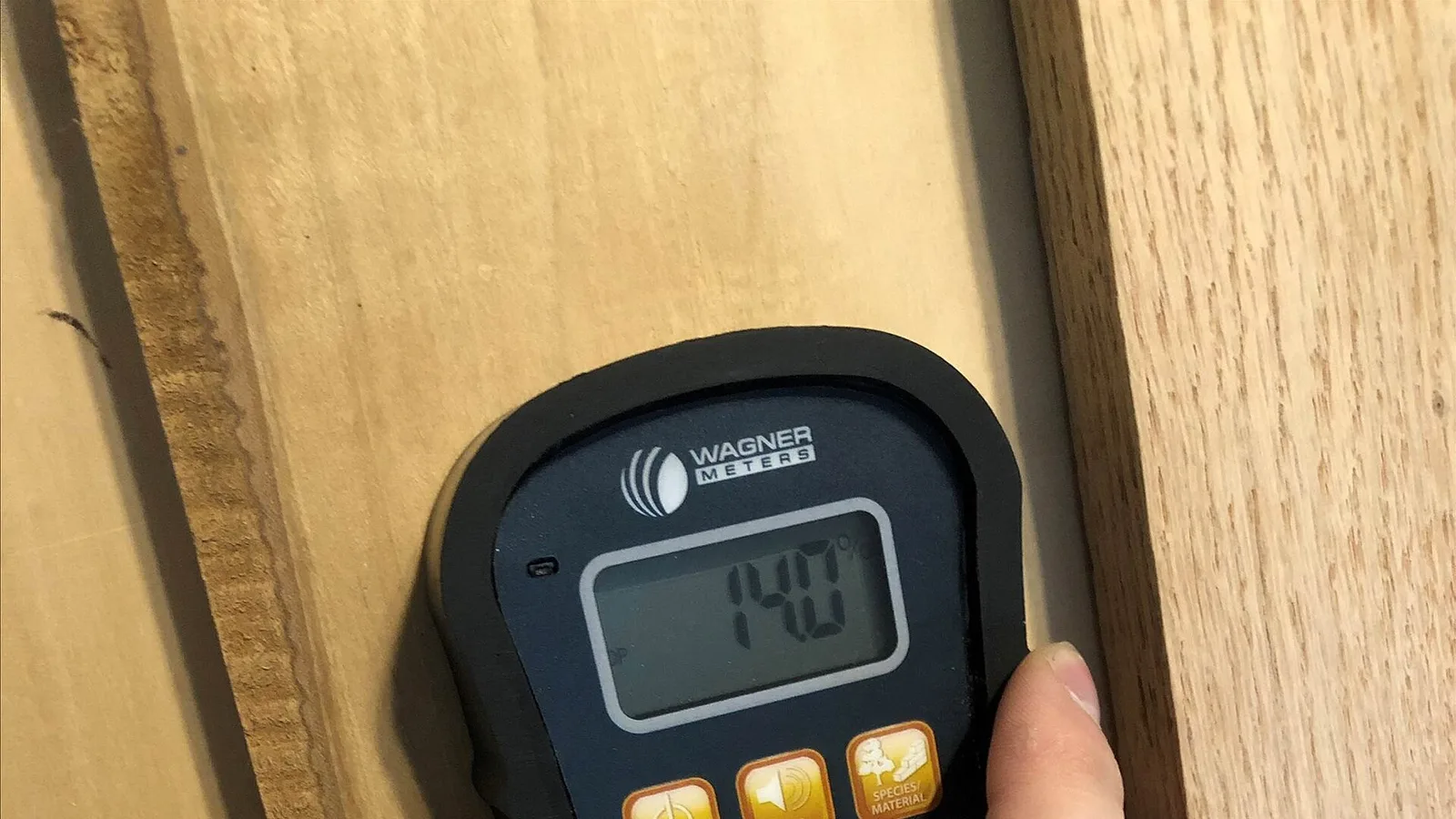
Pin meters pass an electrical signal between two electrodes. They can test at a chosen depth when insulated pins are used, but they leave small holes. Readings are influenced by species, temperature, grain direction, and naturally occurring salts or extractives.
Pinless meters
Pinless meters scan a wider area without puncturing the surface. They are fast for comparing boards, but the sensing depth and minimum stock thickness matter. A thin board, metal below the surface, or a void in an engineered panel can distort the result.
Neither type is automatically “more accurate” in every situation. A meter is most useful as a comparison tool when it is set correctly and used consistently.
How to Take Better Readings
- Confirm the meter’s species or material setting. A reading on oak may need a different correction than the same electrical response on pine.
- Measure away from board ends. End grain exchanges moisture faster and may not represent the center of the stock.
- Test more than one face and more than one location. One reading cannot describe a whole stack.
- Watch for surface moisture. A wet surface can make a board appear wetter than its core.
- Let cold lumber warm before judging it. Temperature can affect both the wood and the instrument.
- Use the same meter and method for comparisons. Consistency often matters more than false precision to a tenth of a percent.
Solid Wood vs Engineered Panels
Solid wood moves predictably with its growth-ring orientation. Engineered panels are designed to reduce that movement, but they are not immune to water. Plywood cross-laminates veneers, so movement in one layer is restrained by the next. MDF and particle board have no continuous grain, yet their fibers and particles can swell severely if liquid water reaches an unprotected edge.
For sheet goods, a handheld meter may provide only a relative reading unless the manufacturer supplies a calibration. Product datasheets and storage instructions take priority.
Moisture Problems to Watch For
Cupping
The board curves across its width. Unequal drying between the two faces can cause temporary cupping; growth-ring orientation and internal stress also matter.
Checking and splitting
The surface or ends dry faster than the interior, creating stress that opens cracks. End coating and controlled drying reduce the moisture gradient.
Joint gaps
A panel assembled too wet may shrink and open gaps later. A dry panel installed in a more humid setting may swell and bind.
Finish problems
Finishing wood before its moisture stabilizes can trap an uneven condition or reveal later movement at joints. A finish slows moisture exchange but does not stop it.
A Practical Pre-Build Routine
Store boards with air able to reach both faces, in conditions reasonably close to the finished location. Take readings when the stock arrives, then repeat them in the same places. Begin final milling when the values have stabilized and are appropriate for the destination. Mill in stages when stock is thick or visibly stressed, giving newly exposed surfaces time to equalize before the last pass.
Moisture measurement cannot guarantee that wood will remain flat. Grain, sawing pattern, drying stress, species, and construction all contribute. It does, however, replace guesswork with evidence—and that is the best reason to own a meter.
References
See the References section for the research sources used on this page.