
Quick Answer
Plain-sawn lumber is cut so the growth rings meet the wide face at a relatively shallow angle—commercially, commonly 0° to 45°. Quarter-sawn lumber places the rings at a steeper angle, commonly 45° to 90°. That orientation changes the face grain, how the board moves across its width, how efficiently the log is used, and often the price.
Plain-sawn is the sensible default for most furniture. Quarter-sawn is worth seeking when straighter grain, lower width movement, or the ray-fleck figure of species such as white oak matters to the design.
The Difference Starts at the End Grain
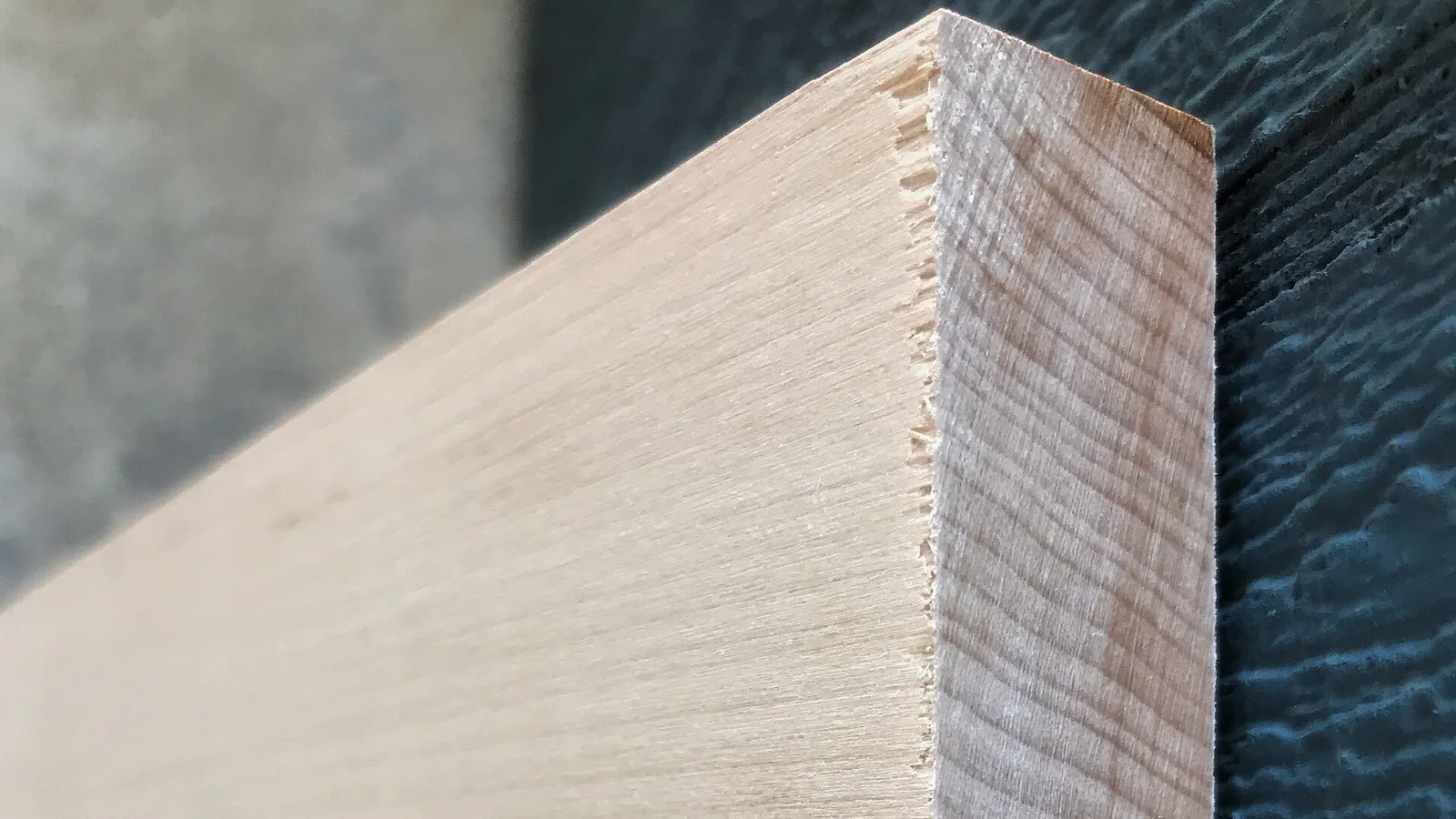
Look at the end of the board rather than the face. On a plain-sawn board, the growth rings tend to run closer to parallel with the wide face. On a quarter-sawn board, the rings stand more nearly perpendicular to it. Real commercial boards often fall somewhere between ideal diagrams, and one wide board can contain both orientations from edge to edge.
The terms also vary by trade. Hardwood sellers commonly say plain-sawn or flat-sawn and quarter-sawn. Softwood suppliers may use flat-grained and vertical-grained or edge-grained for similar orientations.
Grain Appearance
Plain-sawn
Plain-sawn faces often display sweeping “cathedral” arches where the board passes tangentially through growth rings. This lively figure is familiar in oak, ash, pine, and many other species. Near the board edges, the grain may become straighter as the ring angle changes.
Quarter-sawn
Quarter-sawn faces tend to show narrower, straighter stripes. In species with large rays, cutting along the radial surface exposes those rays as reflective flecks or ribbons. Quarter-sawn white oak is the classic example, but ray figure also appears in sycamore, beech, and other species.
The cut does not create rays; it changes the surface on which they become visible.
Movement and Stability
Wood shrinks and swells more tangentially to the growth rings than radially across them. On a plain-sawn board, more of that tangential direction lies across the board’s wide face. On a quarter-sawn board, the radial direction is more closely aligned with the width. Under comparable conditions, the quarter-sawn board therefore changes less in width and has a lower tendency to cup.
That is a useful tendency, not a warranty. A quarter-sawn board with diagonal grain, poor drying, internal stress, or uneven moisture can still twist, bow, check, or cup. A narrow, well-dried plain-sawn board may stay perfectly serviceable for decades.
For the underlying moisture behavior, see Wood Moisture Content.
Yield, Waste, and Price
Plain-sawing moves a log through a relatively efficient cutting pattern and produces wide boards with less handling. Quarter-sawing requires rotating or dividing the log to keep ring angles steep. The process produces narrower boards and generally lower yield from the same log.
Those differences usually make quarter-sawn lumber more expensive. The premium can also reflect sorting: a dealer may select boards for consistent vertical grain or dramatic ray figure rather than selling every board produced by the sawing pattern.
What About Rift-Sawn?
Rift-sawn lumber is a third description, but its commercial definition varies. Woodworkers usually use it for boards whose growth rings meet the face at an angle between plain-sawn and fully quarter-sawn. The face grain is very straight and ray fleck is usually less pronounced than on quarter-sawn oak.
True radial sawing aims each board toward the center of the log, producing exceptionally consistent ring orientation but considerable waste. Retail “rift and quartered” stock is commonly a mixture selected for straight grain rather than a promise that every board was cut by one exact method.
Which Cut Is Better for Furniture?
Choose plain-sawn when:
- cathedral grain is part of the visual design;
- wide boards and efficient material use matter;
- the part is narrow enough that movement is easy to manage;
- lower cost is more important than uniform grain.
Choose quarter-sawn when:
- a wide part would benefit from lower movement across its face;
- straight, restrained grain suits the design;
- ray fleck is a desired feature;
- matching vertical grain across several visible parts matters.
Table tops, cabinet doors, and wide panels can be built successfully from either cut when the construction allows seasonal movement. Drawer sides, rails, and narrow frame parts often gain little from a quarter-sawn premium unless appearance is the goal.
How to Buy the Board You Actually Want
Do not rely on the bin label alone. Examine the end grain, then look down the board for bow, twist, and crook. Compare several boards under the same light because ray fleck and straight grain can be subtle on rough stock. Ask whether the price is for a sawing method, a selected grain appearance, or both.
Most importantly, buy for the part. The best board is the one whose grain orientation, figure, width, and moisture condition suit the component you intend to make—not the one with the most prestigious label.
References
See the References section for the research and extension sources used on this page.