
Quick Answer
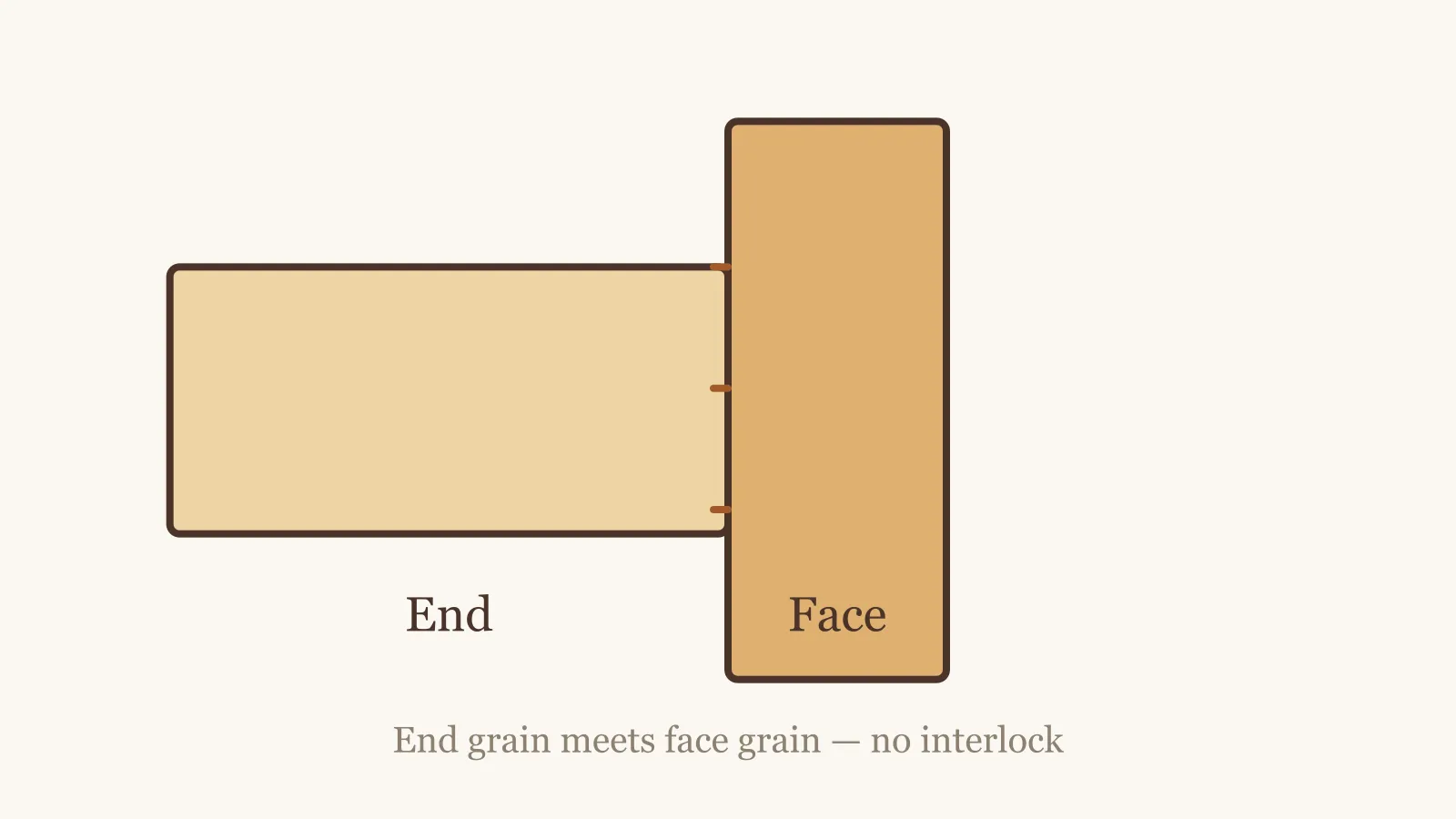
A butt joint is the simplest wood joint there is: one piece is placed against another with no shaping, and the two are joined end to face or edge to edge. Because there is no interlock and one of the glued surfaces is usually end grain, a plain butt joint is weak and is almost always reinforced with screws, nails, dowels, or glue blocks.
How a Butt Joint Works
In a butt joint, the pieces simply meet. There is no mortise, no notch, no overlapping surface — the end of one board is butted against the side or edge of another and fixed in place.
The problem is the gluing surface. End grain is porous and absorbs glue like a straw, so an end-to-face butt joint glued alone has little strength. Fasteners can hold the parts, but they work by pulling the pieces together rather than by adding mechanical interlock.
Where It Is Used
- Simple frames and boxes, usually reinforced
- Face frames joined with pocket screws
- Cabinet carcasses assembled with screws or nails
- Framing and construction where fasteners carry the load
- Situations where speed matters more than strength
Why the Geometry Is Weak
The joint has no shoulders, no cheeks, and no overlap. All of the load falls on whatever is holding the two pieces together — glue on poor surfaces, or fasteners. That is fine when the fastener does the work and the joint only positions the parts. It is inadequate when the joint itself must resist force.
Common Reinforcements
- Screws or nails driven through one piece into the other
- Dowels or biscuits adding alignment and glue surface
- Pocket screws pulling the joint tight
- Glue blocks or brackets inside the corner
- A rabbet or dado adding a recess for the second piece to register into
Advantages
- Fastest and simplest joint to make
- Requires almost no layout or cutting skill
- Useful when fasteners carry the load
- Easy to assemble in production
- Fine for hidden or lightly loaded parts
Limitations
- Weak when glued alone, especially on end grain
- No mechanical interlock
- Relies entirely on fasteners or reinforcement
- Can rack out of square without additional structure
- End grain absorbs glue and weakens the bond
Butt vs Related Joints
A lap joint removes material so the pieces overlap, adding face-to-face glue area. A rabbet or dado joint gives the second piece a recess to sit in. A pocket hole joint is essentially a reinforced butt joint that uses screws at an angle.
Related pages:
Common Mistakes
- Relying on glue alone in a plain butt joint
- Expecting a butt joint to resist racking without reinforcement
- Using a butt joint where pull-apart force is expected
- Assuming all butt joints are equally weak regardless of fastener and structure
References
See the References section for the sources used to write this page.