
Quick Answer
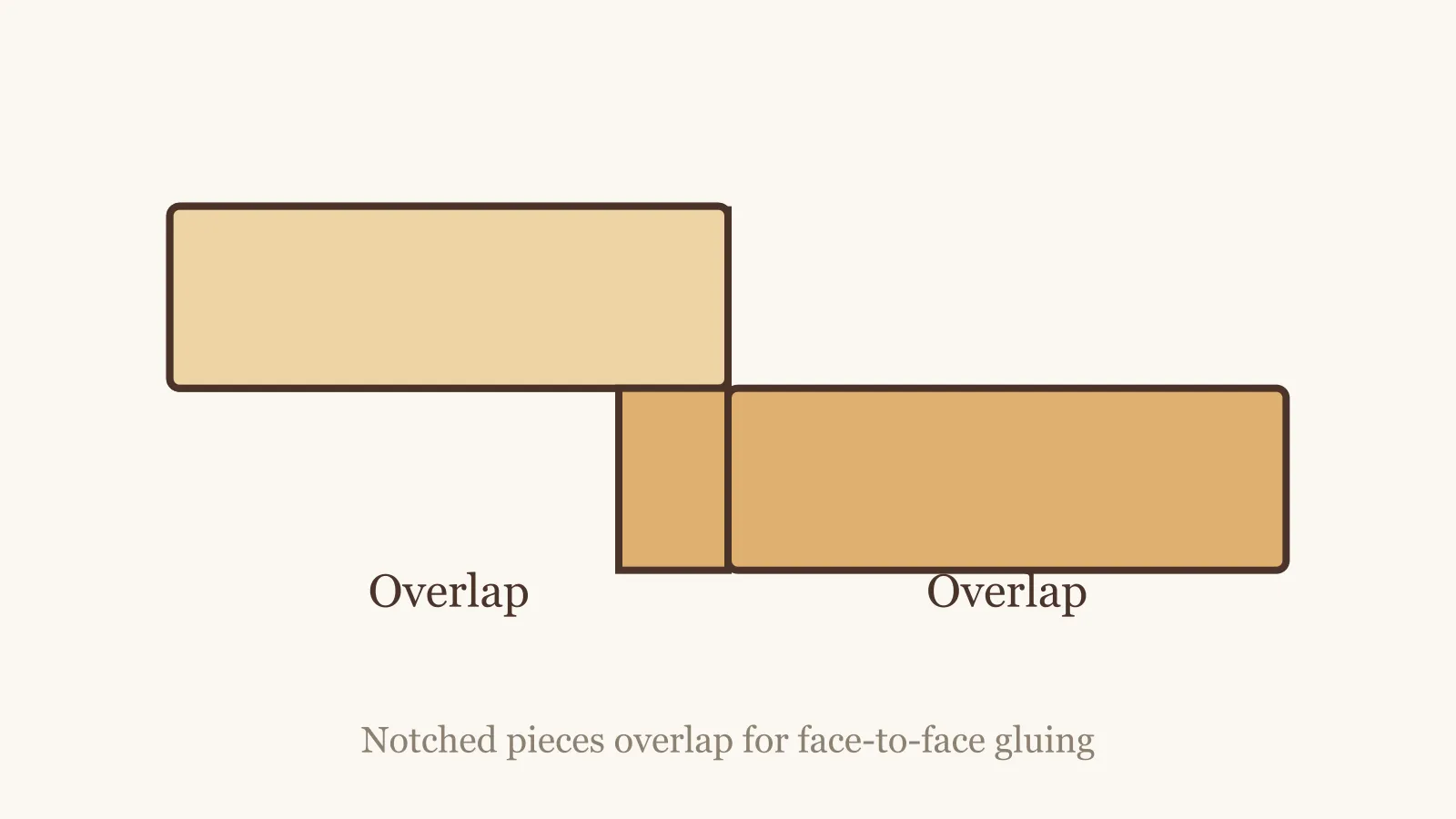
A lap joint joins two pieces by overlapping them, with material removed from one or both pieces so the surfaces sit flush. The overlap creates face-to-face contact and a much larger glued area than a simple butt joint. The most common form is the half-lap, where each piece is notched to half its thickness so the joint lies flat.
How a Lap Joint Works
In a half-lap, each board is cut away by half its thickness for a short distance from the end. The two notched ends then nest together, overlapping and leaving the top and bottom faces flush.
The key improvement over a butt joint is surface area. Where a butt joint glues end grain to face grain, a lap joint glues the face of one notch to the face of the other — a long-grain to long-grain bond that is far stronger. The shoulders of the notches also register the pieces and resist sliding.
Where It Is Used
- Frames and rails where pieces cross or meet at corners
- Furniture frames and bracing
- Door and window construction
- Laminated or reinforced assemblies
- Joining pieces of similar thickness
Why the Geometry Works
The joint works by replacing a weak end-grain contact with an overlapping face-to-face contact. The load is spread over the whole overlap rather than concentrated on a seam. The shoulders add registration, so the joint helps the assembly stay square during glue-up.
Performance still depends on fit, species, adhesive, and loading direction. A gap-filled half-lap loses much of its strength.
Main Variations
- Half-lap, the basic notch-in-notch overlap
- Cross lap, where two pieces cross in the middle
- End lap and T-lap, depending on where the pieces meet
- Mitered half-lap, used at frame corners
Advantages
- Stronger than a butt joint thanks to face-to-face gluing
- Registers the parts and helps keep them aligned
- Relatively simple to cut
- Flush surfaces when notched accurately
- Good glue area for its simplicity
Limitations
- Removes material, slightly weakening each piece
- Not as strong as a mortise and tenon
- Fit and flatness of the notches matter
- Visible seam on one face
- Less suited to thin stock
Lap vs Related Joints
A butt joint has no overlap at all. A rabbet or dado joint gives one piece a recess to sit in rather than overlapping both. A finger joint is a more elaborate interlocking version of the same idea.
Related pages:
Common Mistakes
- Confusing a lap joint with a simple butt joint
- Assuming any overlap guarantees strength without good fit
- Notching too deeply and weakening the stock
- Ignoring grain direction in the overlap
References
See the References section for the sources used to write this page.