
Quick Answer
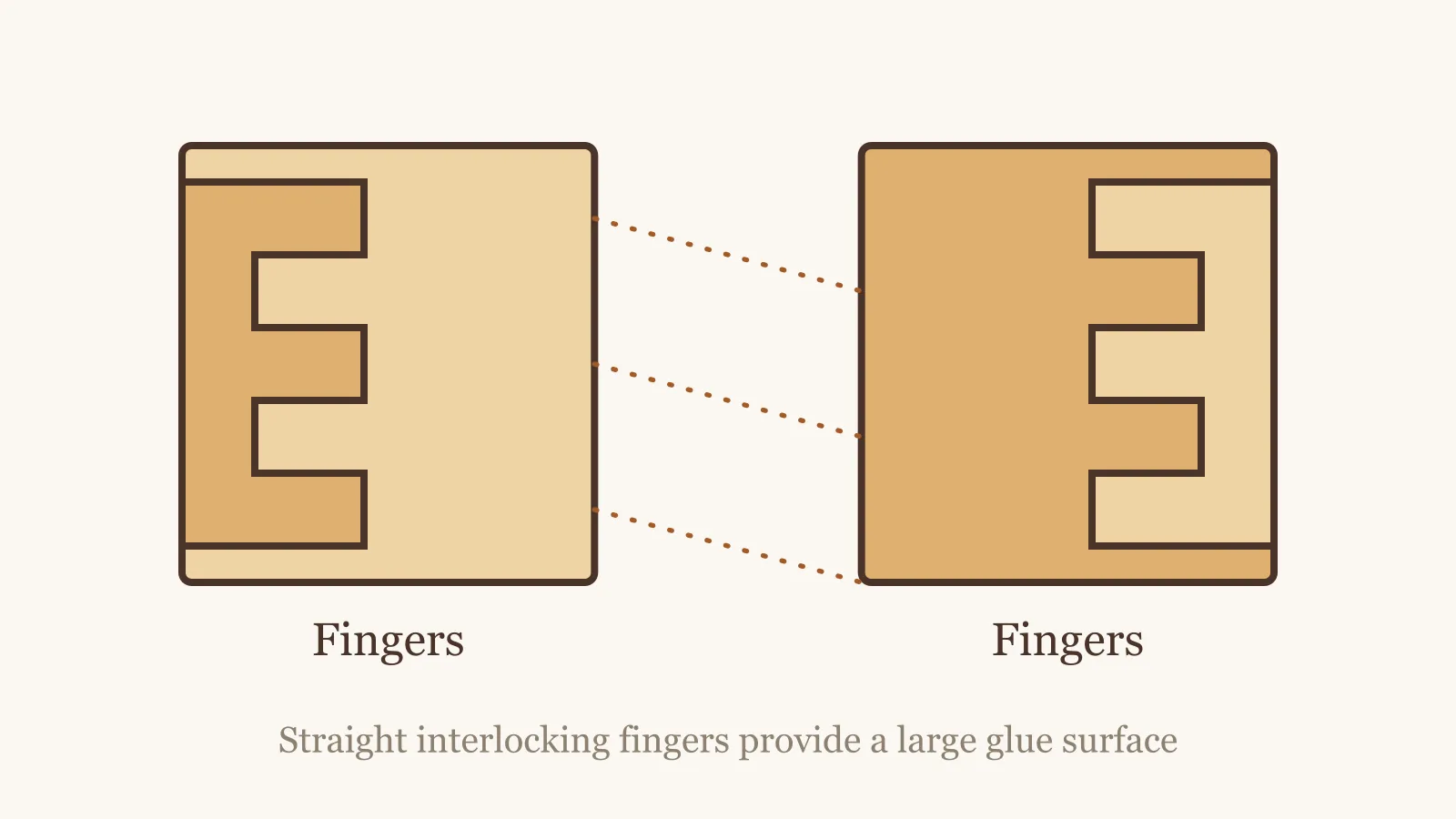
A finger joint — also called a box joint or comb joint — joins two boards with interlocking rectangular fingers cut into their ends. The fingers mesh together and provide a very large glued surface. Unlike a dovetail, the fingers are straight-sided, so the joint has no mechanical lock against pull-apart; its strength comes almost entirely from glue area.
How a Finger Joint Works
The ends of both boards are cut into a series of matching rectangular projections and gaps. The fingers of one board fit into the gaps of the other, and glue is applied to every contacting face.
Because the fingers are straight, they can slide apart unless the glue holds. But the amount of glued surface is enormous — many times the glue area of a butt joint — and all of it is long grain to long grain, which bonds well.
Where It Is Used
- Box corners and drawer sides
- Joining boards end to end in longer lengths
- Decorative joinery where the pattern is visible
- Casework corners where a strong glued joint is wanted
Why the Geometry Works
The strength is a matter of surface area. Each finger adds two long-grain faces to the glue line, and a typical box joint has many fingers. The interlocking shape also registers the parts so they stay aligned during assembly.
What the geometry does not provide is mechanical lock. Pull the two pieces straight apart and the glue must resist the whole load — unlike a dovetail, whose flared tails would have to shear the wood to pull out.
Main Variations
- Box joint, with fingers of equal width
- Dovetail, where the fingers are flared to create a mechanical lock
- Machine-cut finger joints for end-to-end board joining
Advantages
- Very large glued surface
- Strong for its simplicity
- Simple to cut with a jig
- Registers the parts accurately
- Decorative pattern when visible
Limitations
- No mechanical lock against pull-apart
- Requires accurate cutting for a tight fit
- The end grain pattern is visible unless covered
- Not as resistant to pull-out as a dovetail
- Fit and glue quality decide the strength
Finger vs Related Joints
A dovetail uses flared tails instead of straight fingers, adding mechanical interlock. A lap joint overlaps two pieces without interlocking fingers. The finger joint is essentially the maximum-glue-surface version of the same corner joinery.
Related pages:
Common Mistakes
- Calling a finger joint a dovetail
- Assuming the interlock provides mechanical strength
- Cutting loose-fitting fingers and expecting a strong joint
- Ignoring that all the strength is in the glue line
References
See the References section for the sources used to write this page.