
Quick Answer
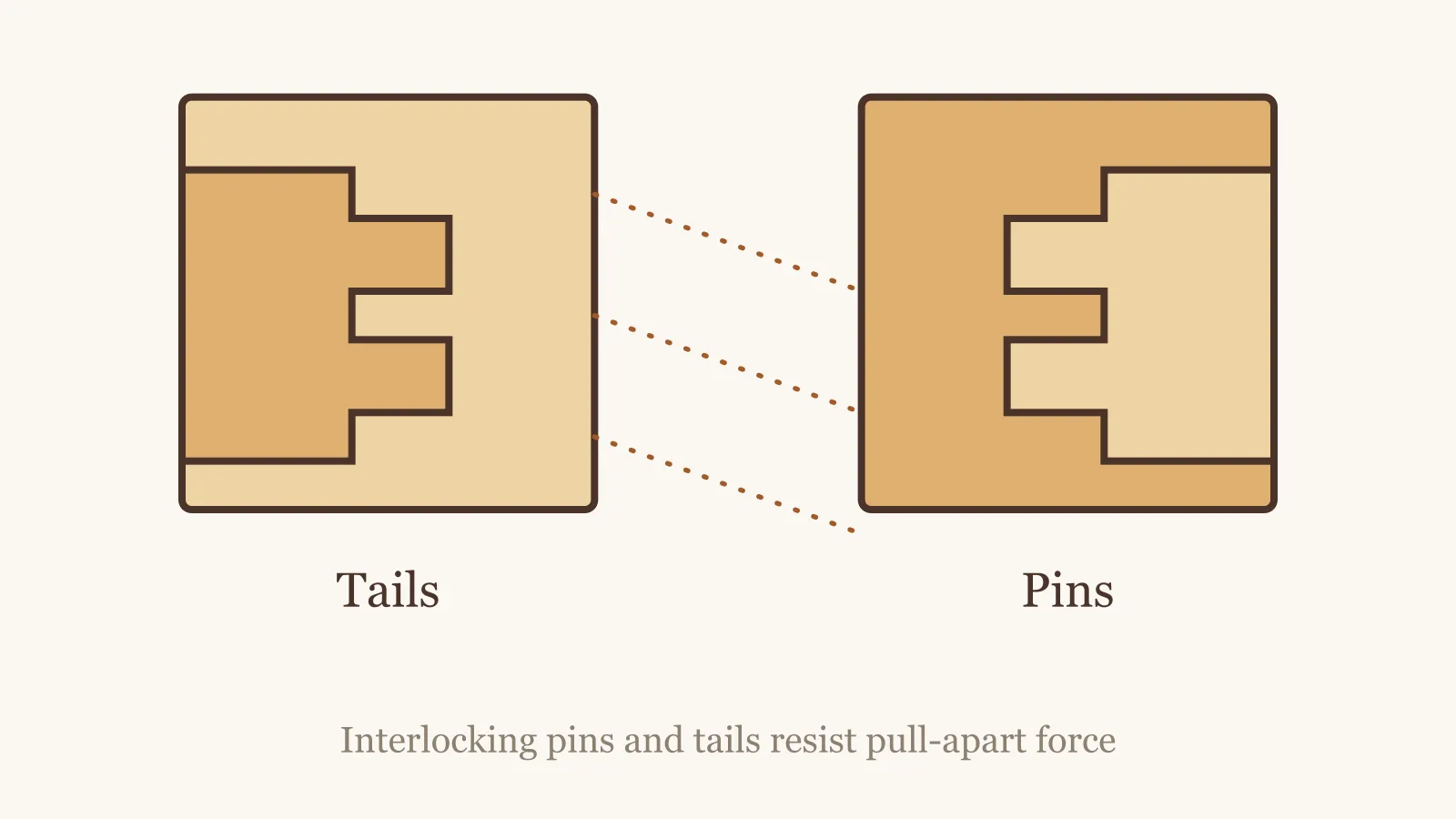
A dovetail joint connects two boards with interlocking, wedge-shaped projections called pins and tails. The tails flare outward, so the joint resists being pulled apart in one direction even without glue. Dovetails are most famous for drawer boxes and fine casework, where they combine mechanical strength with a strong visual signature.
How a Dovetail Joint Works
The joint is cut at the corner where two boards meet, usually at a right angle. One board carries a series of tails — flared, trapezoid-shaped pieces. The other board carries matching sockets, with the pins cut between them. When the two boards are fitted together, the flared tails lock inside the sockets.
Because the tails are wider at the end than at the base, the two boards cannot be pulled straight apart along the length of the joint. That mechanical interlock is the defining feature of a dovetail, and it means the joint holds even if the glue fails.
Where It Is Used
- Drawer boxes, joining the sides to the front
- Fine boxes and chests
- Carcass construction in quality casework
- Joining boards at corners where pull-apart force is expected
Dovetails are as much a marker of craftsmanship as a structural choice, which is why they are often left visible.
Why the Geometry Works
The strength comes from the shape. A straight finger can slide out of its socket; a dovetailed tail cannot, because it is wider at the tip than at the root. Pulling the joint apart would require shearing the wood itself, not just overcoming glue.
That said, real performance is never geometry alone. It also depends on wood species, joint fit, grain direction, adhesive, workmanship, and the direction of the load.
Main Variations
- Through dovetail, where the joint is visible from both faces
- Half-blind dovetail, where the joint is hidden on one face — typical of drawer fronts
- Sliding dovetail, used to join a shelf or divider into a groove
The same principle — a flared tail in a matching socket — runs through all of them.
Advantages
- Mechanical interlock resists pull-apart force
- Strong even if glue degrades over time
- Large glue surface along the grain
- Recognized mark of quality
- Durable for decades in well-made drawers
Limitations
- More demanding to cut accurately than many joints
- Hand-cutting takes skill and time; jigs help for machine cutting
- Fit matters: a sloppy dovetail loses much of its strength
- Requires accurate layout and careful waste removal
Dovetail vs Related Joints
A finger joint uses straight, rectangular fingers rather than flared tails, giving lots of glue surface but no mechanical lock against pull-apart. A mortise and tenon resists different forces and is used for frame construction rather than corner joinery.
Related pages:
Common Mistakes
- Calling any box corner a dovetail when it is a finger joint
- Assuming every dovetail is automatically strong regardless of fit
- Judging strength without considering species and glue
- Claiming dovetails are always stronger than every other joint
References
See the References section for the sources used to write this page.