
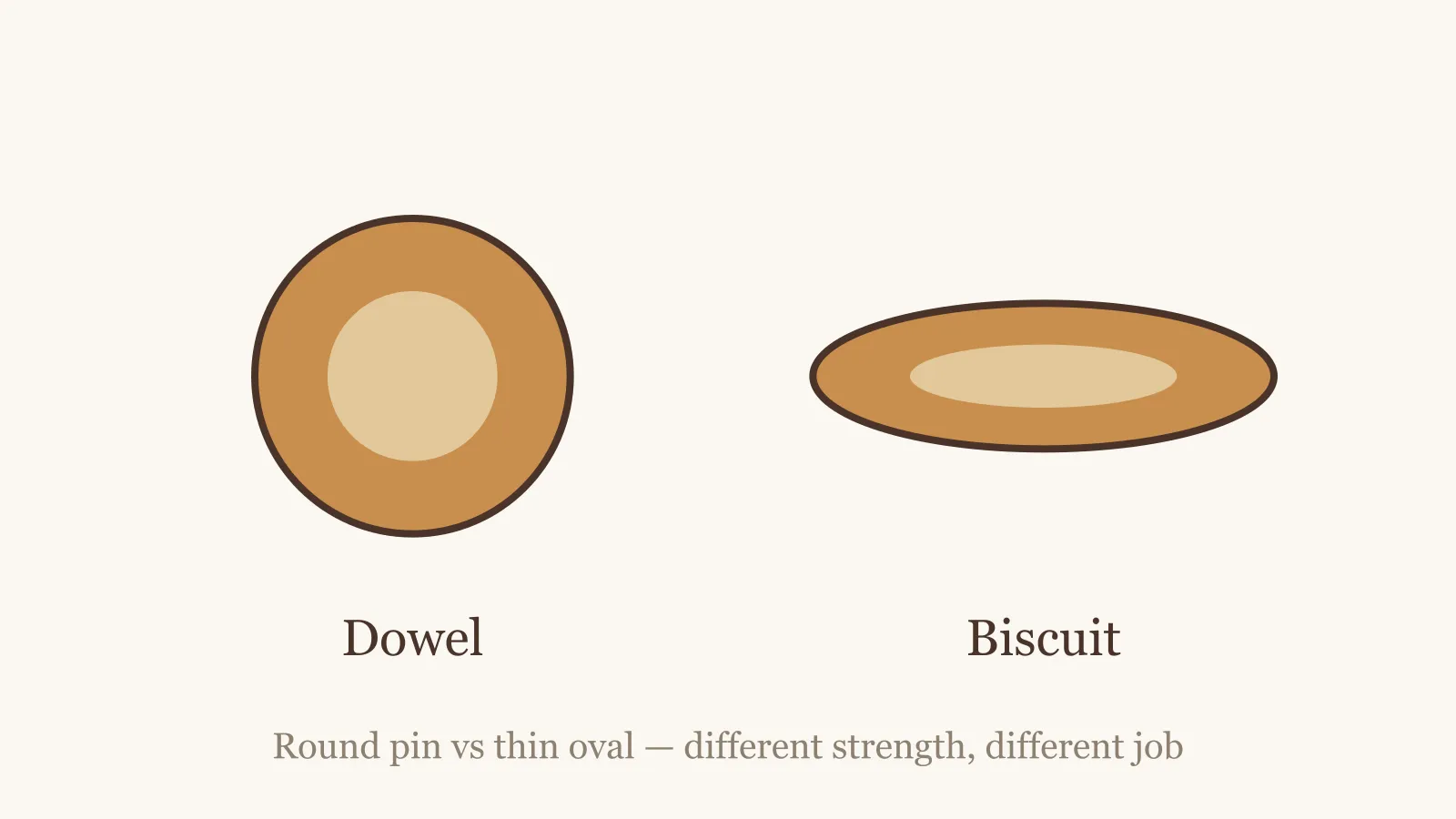
Quick Difference
Use dowels when the joint needs accurately located reinforcement and you can drill matching holes reliably. Use biscuits when keeping panel faces flush during assembly matters more than fixing their position along the joint. Neither name gives a load rating: material, insert size, spacing, glue coverage, and the direction of force all affect the result.
For an ordinary edge-glued solid-wood tabletop, well-prepared long-grain edges provide the main bond. Biscuits can help with alignment, but adding them does not remove the need for straight edges or a clamping plan.
What Each Insert Actually Does
A dowel bridges matching round holes. Its fit locates the parts across the joint, while the dowel and surrounding wood transfer forces after gluing. Two or more separated dowels can also help resist rotation. A single dowel by itself does not accurately locate a part against twisting.
A biscuit fits matching crescent-shaped slots. The slot usually allows some movement along its length, which is useful when aligning a long panel or positioning a divider. The compressed wood biscuit absorbs moisture from suitable glue and tightens in its slot; that behavior is not a substitute for following the adhesive instructions.
Choose by the Assembly
| Assembly | Useful starting point | What still needs attention |
|---|---|---|
| Edge-glued solid-wood top | Biscuits if alignment assistance is needed | Straight mating edges, face alignment, and pressure distribution |
| Cabinet divider or shelf joint | Dowels or another designed panel joint | Core strength, hole placement, and support under the shelf |
| Wide panel assembled in stages | Biscuits for some positioning tolerance | Reference faces must be consistent across every cut |
| Rail-to-leg furniture joint | Evaluate dowels alongside a mortise and tenon | Racking loads, member size, embedment, and the whole frame |
| Thin stock or a narrow rail | Check whether either insert fits first | Avoid breaking through a face or leaving weak walls |
These are selection prompts, not proof that a particular joint is suitable for a chair, step, or other safety-critical assembly.
Why Accuracy Matters Differently
Dowels demand matching hole positions. A small error can keep shoulders apart or twist an otherwise square assembly. Drill from the same marked reference face, control depth, and test the jig on offcuts of the actual thickness. A nominal board thickness is not enough to establish the drilling position.
Biscuit slots are more forgiving along their length, but their height still matters. If one cut references the top face and the other references the bottom, small thickness differences can create a step at the seam. Keep one reference convention throughout the assembly.
For both systems, dry-assemble the whole joint before adding glue. Check that the shoulders close and that the insert does not bottom out. A clamp should close a correctly fitted joint, not force badly aligned parts into position.
Strength: Avoid a Universal Ranking
Dowels are often selected for reinforcement in furniture and cabinet joints, while biscuits are frequently selected for alignment. That practical distinction does not establish a fixed strength ratio. A poorly fitted dowel joint can perform worse than a well-made alternative, and an insert cannot compensate for a weak or damaged panel core.
The relevant failure may be the insert breaking, the surrounding material splitting, glue separating, or the entire cabinet racking. Choose reinforcement for that failure mode rather than buying a joint because it is described as stronger.
For frame work that experiences repeated leverage, compare the geometry with a mortise and tenon, including its shoulders and remaining wood around the mortise. Do not transfer a tabletop alignment method directly to a chair rail.
A Practical Setup Sequence
- Identify which faces must finish flush and mark them.
- Confirm that the insert and machining depth suit the actual stock.
- Make a complete test joint in matching offcuts.
- Assemble without glue and check closure, squareness, and alignment.
- Follow the adhesive’s application, open-time, pressure, and curing instructions.
- Check the assembly again after clamping; parts can move as pressure is applied.
If you already own a reliable doweling jig, a few carefully placed dowels may be simpler than buying a biscuit joiner. If you regularly glue wide panels, a biscuit joiner may make alignment more convenient. Tool availability is a reasonable deciding factor once the joint is appropriate for the job.
References
The sources below explain wood bonding and joint design principles. They do not establish a universal dowel-versus-biscuit strength score.