
Quick Answer
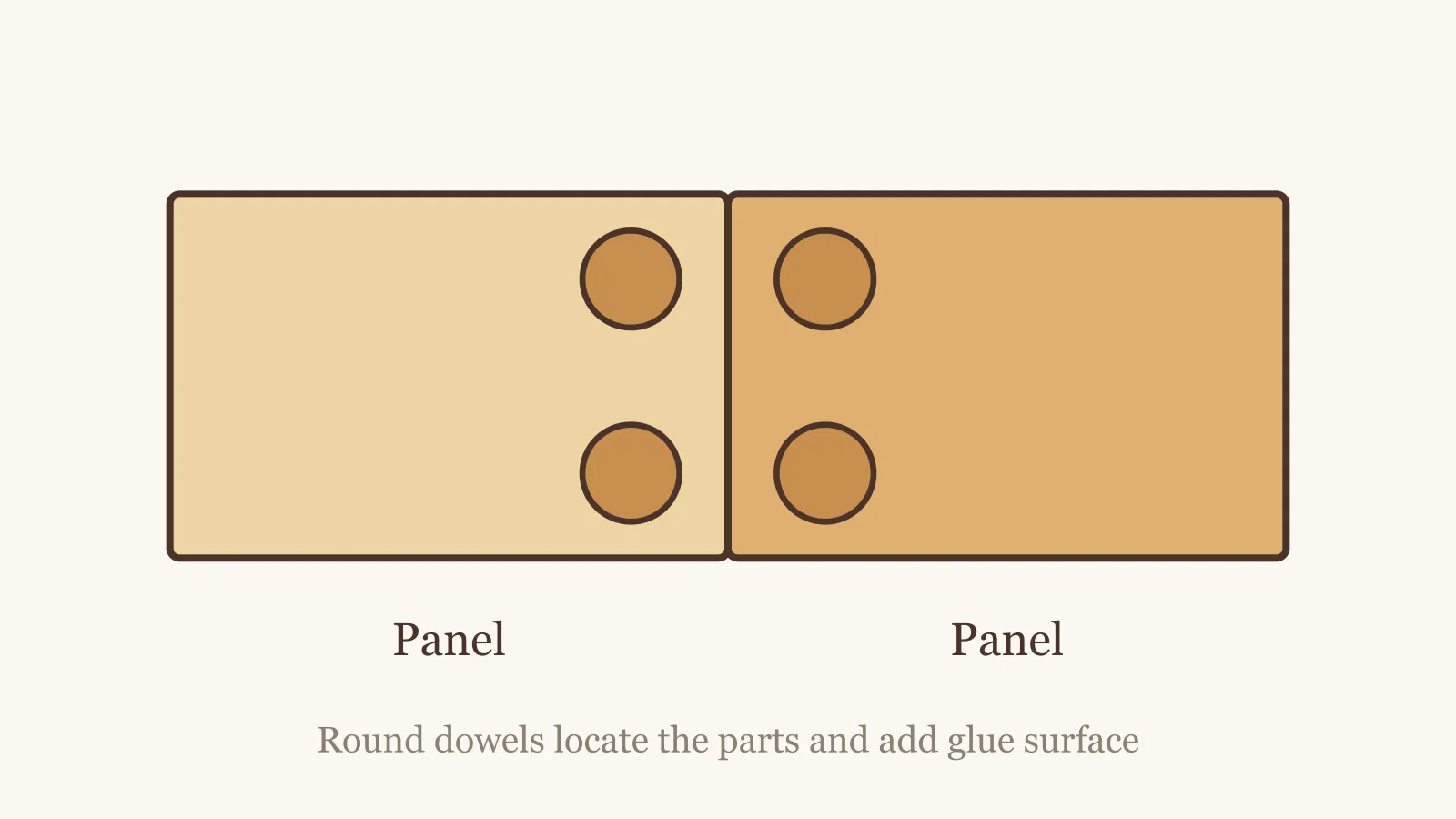
A dowel joint joins two pieces of wood with short round wooden pins called dowels. Holes are drilled into the matching faces, glue is applied, and the dowels are inserted so the pieces align and bond. Dowel joints are widely used to align panels, carcasses, and furniture parts, and they provide a moderate strength between a butt joint and a mortise and tenon.
How a Dowel Joint Works
The two parts to be joined are clamped together or accurately marked, and matching holes are drilled into each face. Glue is spread in the holes and on the dowels, and the dowels are driven home. The dowels locate the parts precisely and add the cylindrical surface of each dowel to the glue area.
Because the dowel enters both pieces, the joint resists sliding and twisting better than a plain butt joint. It still relies on glue rather than mechanical interlock, so the fit of the holes and the quality of the bond matter.
Where It Is Used
- Panel edge-to-edge alignment
- Cabinet carcass assembly
- Furniture joints in chairs, tables, and frames
- Positioning parts during glue-up
- Production joinery where drilling jigs speed assembly
Why the Geometry Works
A dowel joint works by increasing glued surface area and by registering the parts. Each dowel adds a glued cylinder that spans the joint line, and the set of dowels together prevents the parts from shifting. Compared with a butt joint’s end-grain contact, the dowel surfaces bond far better.
Strength depends on dowel size and number, hole accuracy, adhesive, and the fit of the parts. A dowel joint is only as good as its alignment.
Advantages
- Simpler to machine than a mortise and tenon
- Accurate alignment with a drilling jig
- More glue surface than a butt joint
- Hidden inside the joint
- Fast in production
Limitations
- No mechanical interlock; relies on glue
- Requires accurate hole spacing
- Dowels can be crushed or split thin stock
- Strength below a well-fitted mortise and tenon
- Fit quality is harder to inspect after assembly
Dowel vs Related Joints
A biscuit joint also uses a hidden insert, but the insert is a thin oval that mostly aligns the joint. A mortise and tenon uses a solid tongue of wood and provides more glued surface and mechanical shoulders.
See the direct comparison:
Common Mistakes
- Assuming dowels are always stronger than biscuits without considering fit
- Drilling holes without a jig and misaligning the parts
- Using too few or too thin dowels for the load
- Treating dowel joints as having mechanical interlock
References
See the References section for the sources used to write this page.