
Quick Answer
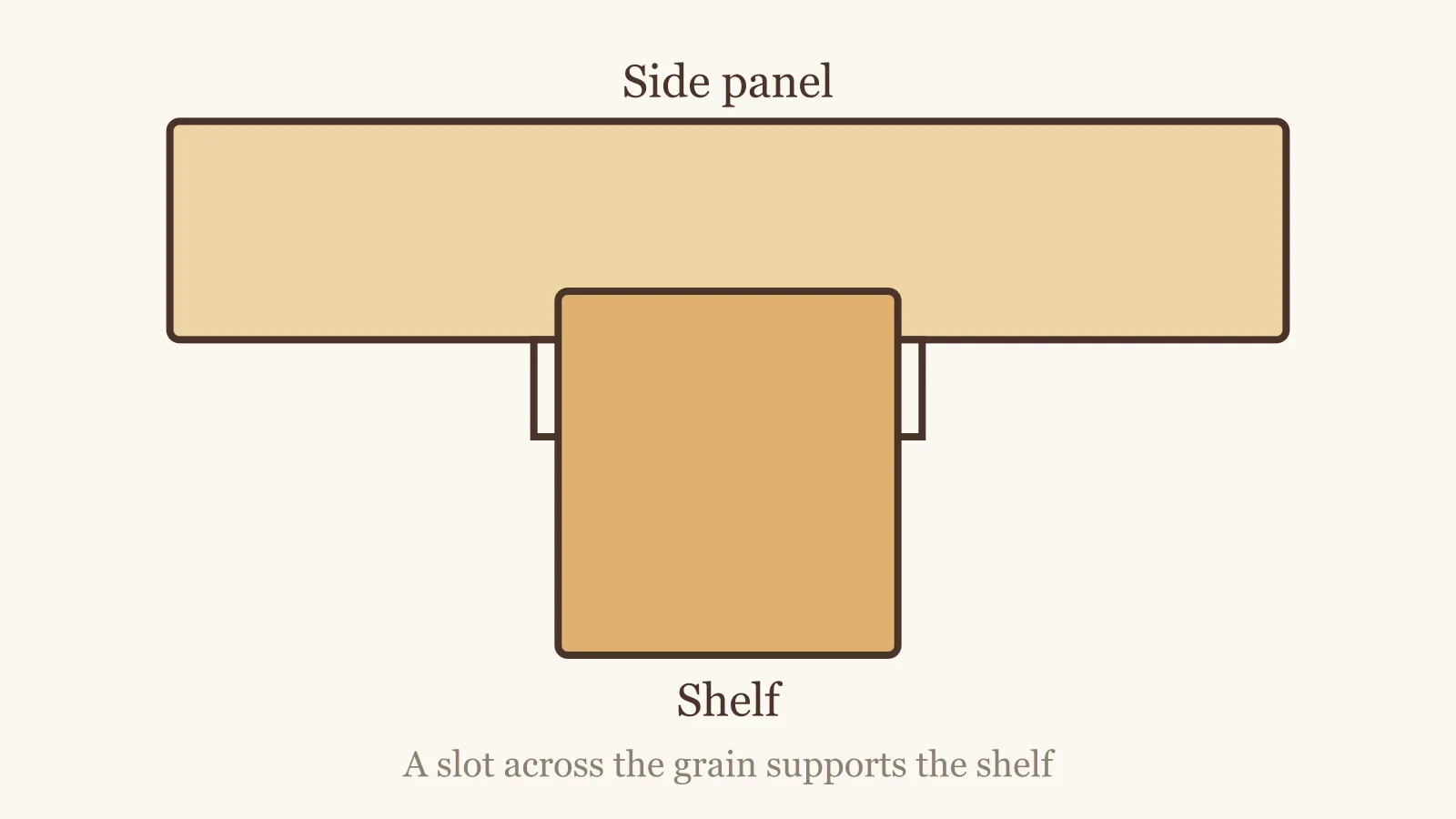
A dado joint is a slot cut across the grain of one panel into which the end of another panel fits. The slot supports the second panel along its entire width, giving the joint large gluing surfaces and good resistance to load. Dados are the standard way to join fixed shelves into bookcase and cabinet sides.
How a Dado Joint Works
A rectangular channel is cut across the face of one board — usually the side of a cabinet or bookcase. The mating panel’s end is fitted into the channel and glued in place. The slot cradles the panel on three sides: the bottom and both walls.
That full-width support is what makes the joint useful for shelves. A shelf in a dado rests on the bottom of the slot, and the slot walls brace it against tipping and racking.
Where It Is Used
- Fixed shelves in bookcases and cabinets
- Dividers and partitions in casework
- Cabinet interiors
- Drawer guides and internal panels
Why the Geometry Works
The dado works by replacing a simple end-to-face contact with a seated joint. The panel’s end sits inside the slot, so the load on the shelf is carried by the bottom wall of the dado in compression, while the side walls add glue area and resist movement.
Because the slot runs across the grain, the two pieces expand and contract differently with humidity. That is a normal consideration, not a defect, and good design allows for it.
Main Variations
- Through dado, cut the full width of the board
- Stopped dado, hidden at the front edge
- Dado with a rabbet, combining the two recesses
Advantages
- Full-width support for shelves and panels
- Large, well-braced glue surface
- Strong in the direction shelves are loaded
- Simple to cut on a table saw or router
- Registers parts accurately
Limitations
- Slot is cut across the grain, so seasonal movement matters
- No mechanical interlock against direct pull-out
- Slightly reduces the panel’s strength where cut
- Requires accurate width for a good fit
- Visible at the front unless stopped
Dado vs Related Joints
A rabbet is cut along an edge, while a dado is cut across a face. A lap joint overlaps two pieces; a dado seats one piece into a slot. Both rabbets and dados add support and glue surface compared with a butt joint.
Related pages:
Common Mistakes
- Confusing a dado with a rabbet
- Ignoring wood movement across the grain of the slot
- Cutting the slot too wide and losing the glue bond
- Using a dado where a shelf must be adjustable
References
See the References section for the sources used to write this page.