
Quick Answer
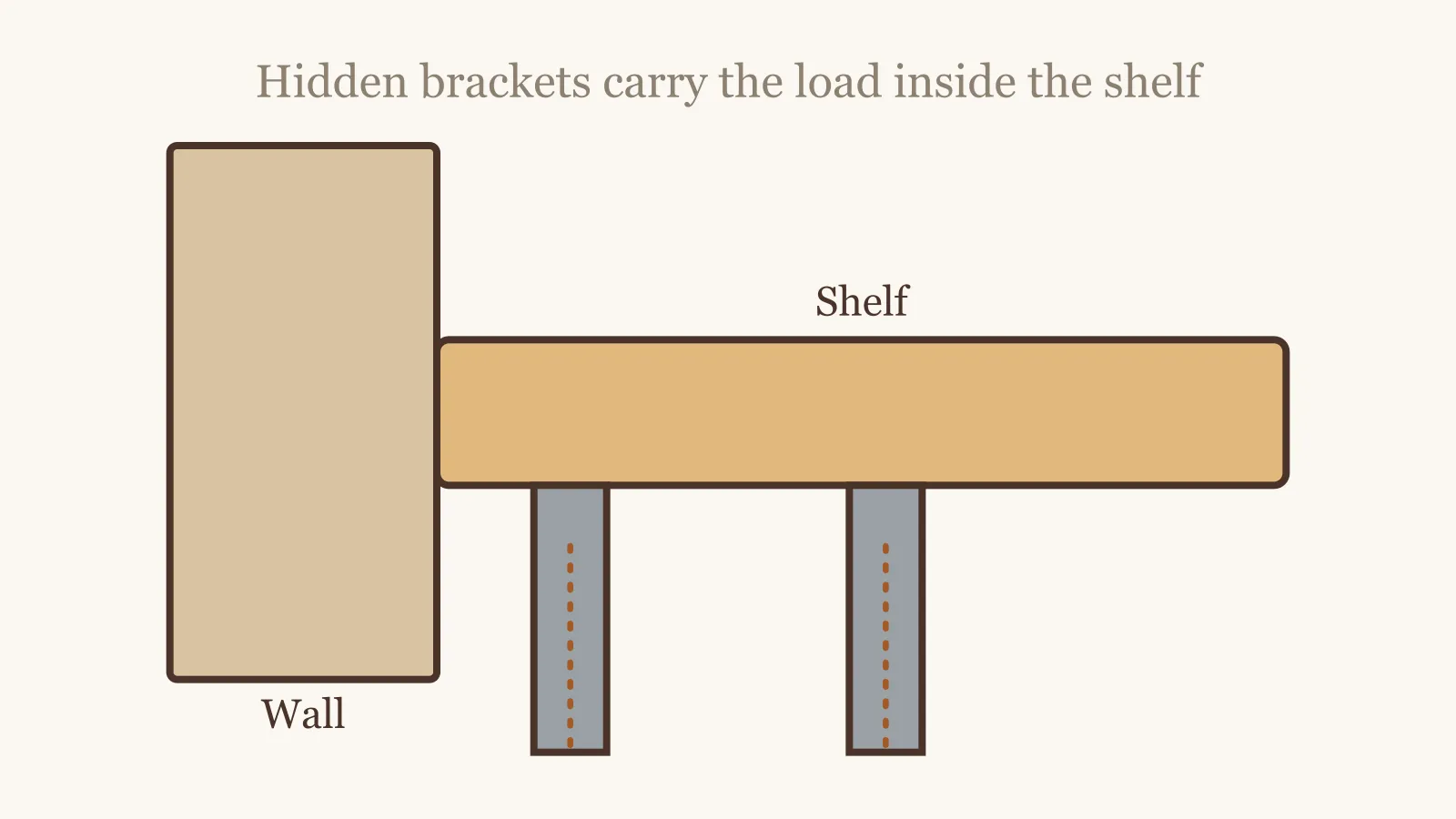
A floating shelf is a shelf that appears to be supported by nothing, with no visible brackets underneath. The support comes from hidden hardware — rods, brackets, or plates — that extends into the back of the shelf and fixes to the wall. The result is a clean, minimalist shelf, but its real load capacity depends on the hidden hardware and the wall it is fixed to.
How a Floating Shelf Works
The shelf has a recess or cavity in its back edge. A bracket or a set of rods is fixed to the wall first, and the shelf is then slid or lowered onto that hardware so the support disappears inside the shelf. Once mounted, only the shelf itself is visible.
The hidden hardware is doing the structural work. Some brackets are simple rods; others are reinforced plates designed for heavier loads. The type and number of brackets, plus the wall material and fixings, decide what the shelf can hold.
What the “Floating” Look Depends On
- Hardware that fits fully inside the shelf
- A wall that can carry the load with proper fixings
- A shelf thick enough to house the hardware
- Correct leveling and alignment during installation
The floating appearance is a hardware and installation effect, not a property of the shelf board alone.
Where Floating Shelves Are Used
- Living room and bedroom display shelves
- Bathroom shelving
- Kitchen open shelving
- Retail and display fixtures
Advantages
- Clean, uncluttered appearance
- No visible brackets or supports
- Works in many rooms and styles
- Available in many materials and finishes
Limitations
- Load capacity is set by the hardware and wall
- Requires solid wall fixings, especially for heavy items
- Thin shelves limit the hardware that can be used
- Can sag or pull away if overloaded or poorly mounted
Common Mistakes
- Assuming the shelf supports itself with no hardware
- Overloading a floating shelf beyond its bracket rating
- Mounting into weak wall material without proper fixings
- Judging capacity by the shelf’s appearance alone
References
See the References section for the sources used to write this page.