
Quick Answer
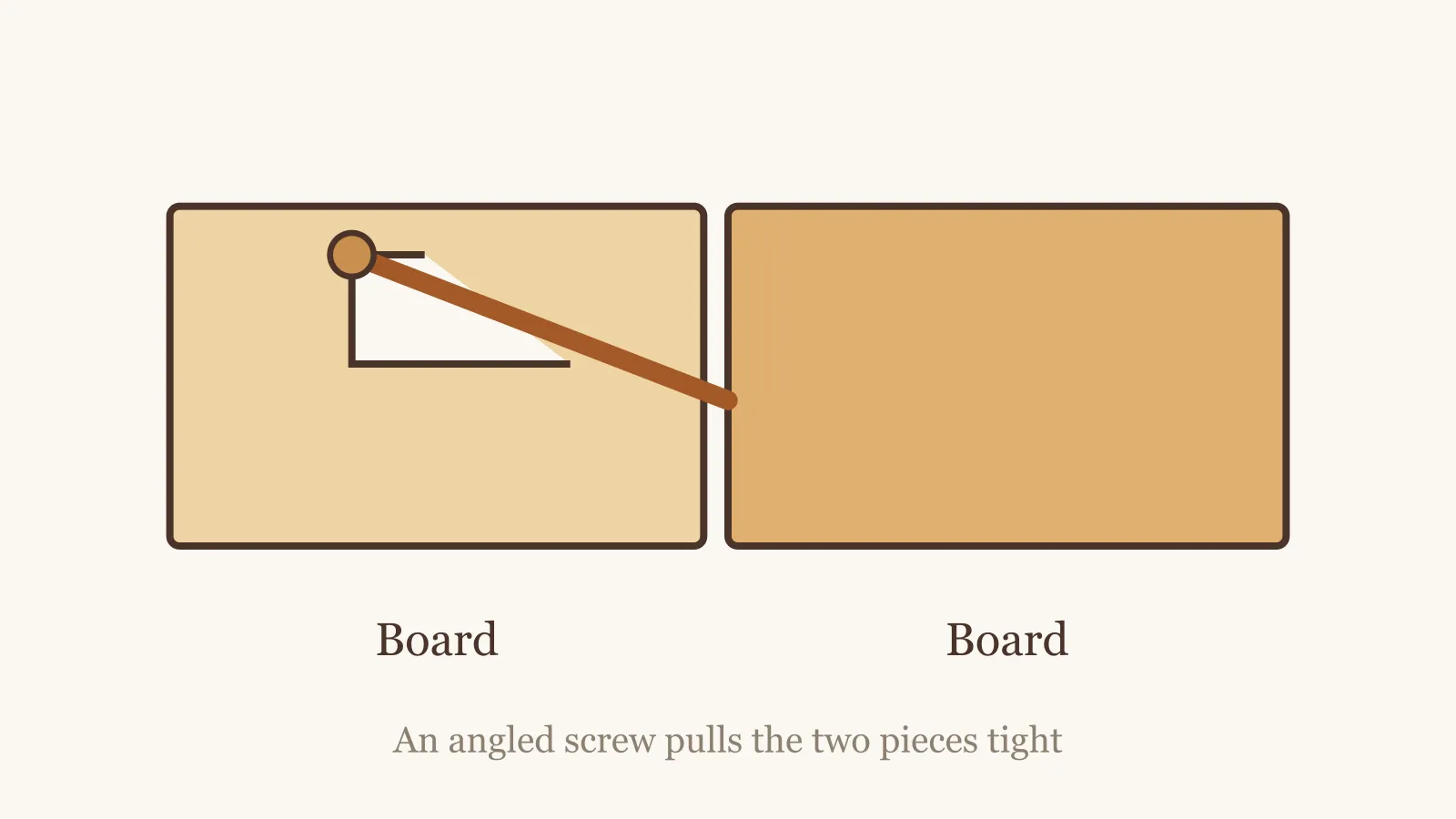
A pocket hole joint joins two pieces with screws driven at an angle through a stepped hole drilled in one piece. The screw enters the mating piece across the joint line and pulls the two parts tightly together. Pocket hole joinery is fast, needs no clamping time, and is widely used for face frames and cabinet assembly.
How a Pocket Hole Joint Works
A jig guides a drill bit at a steep angle, creating a pocket — a recess with a pilot hole running at an angle through the piece. A special flat-head screw is driven through the pocket, and the angled pilot directs it out of the end of the piece and into the adjoining piece.
Because the screw enters at an angle across the joint, tightening it pulls the two pieces together and clamps the joint shut. No separate clamp is needed, and the assembly can be handled immediately.
The joint is a reinforced butt joint. The screw does the structural work, and the pocket positions it so that the thread engages both pieces across the seam.
Where It Is Used
- Cabinet face frames
- Cabinet and furniture carcass assembly
- Furniture frames and aprons
- Drawer boxes
- Quick production joinery
Why the Geometry Works
The strength comes from the screw, not from wood geometry. The angled pilot directs the screw diagonally through the joint, so the screw head and threads pull the two parts together instead of simply pinning them side by side. The stepped pocket also lets the screw head sit below the surface.
The trade-off is that the joint is only as strong as the screw and the material it bites into. In particle board or MDF, screw holding is weaker than in solid wood or plywood.
Advantages
- Very fast to make with a jig
- No clamping time needed
- Strong enough for many cabinet and frame joints
- Hidden pockets can be filled or covered
- Easy for beginners and production shops alike
Limitations
- Relies on screws; weaker in soft or particle cores
- The pocket hole is visible unless filled or placed out of sight
- Screws can split thin or brittle stock
- Less refined than traditional joinery
- Not a mechanical interlock
Pocket Hole vs Related Joints
A plain butt joint has the same basic geometry but without the angled screw. A dowel or biscuit joint aligns parts without visible fasteners. A mortise and tenon provides far more structural strength but takes far more time.
Related pages:
Common Mistakes
- Using pocket screws in particle board where screw holding is weak
- Expecting a pocket screw joint to match a mortise and tenon
- Splitting the stock with screws that are too long
- Leaving pockets visible on a finished face
References
See the References section for the sources used to write this page.